Ember
Daily AI market calls locked before outcomes, with public scores and unedited signals when three AIs disagree by 10 points.
Visit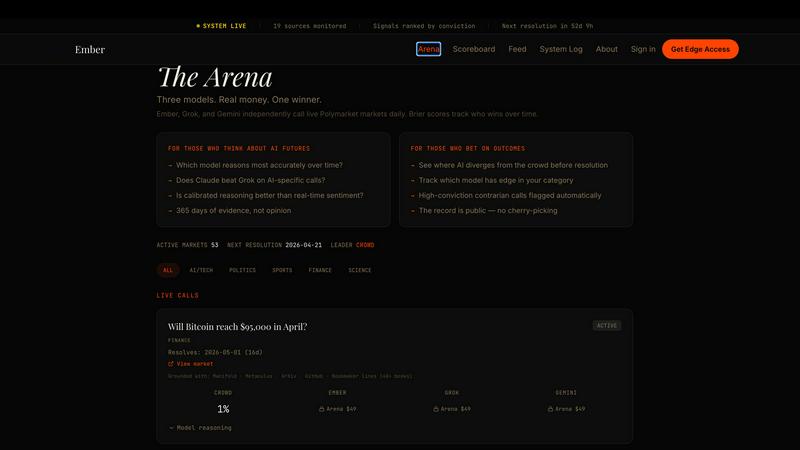
About Ember
Ember is a public AI prediction engine built on a radical premise: an artificial intelligence that won't show its work is not worth trusting. Every morning at 7:00 AM EST, three genuinely independent AI models — Claude by Anthropic, Grok by xAI, and Gemini by Google — independently call live Polymarket markets before they resolve. They do not consult each other. They do not coordinate. When any model's probability diverges from the real-money crowd by 10 or more points, that divergence is flagged as a high-conviction signal. Every call is timestamped before the outcome is known. Accuracy is tracked using Brier scores, a calibration metric that rewards both precision and confidence. The model that beats the crowd most consistently across a full 365-day cycle wins. Nothing is edited after the fact. Every wrong call receives a public post-mortem. The entire record builds in plain sight. Ember is designed for serious bettors, quantitative traders, analysts, and anyone who wants a transparent, verifiable edge in prediction markets. It synthesizes data from over 20 sources — including Polymarket, Manifold, Metaculus, live sports odds, arXiv research feeds, Hugging Face papers, Product Hunt launches, and real-time X sentiment — before any call is made. Subscribers see signals at 7:00 AM EST, before public release. The edge is timing. The proof is the record.
Features of Ember
Three Independent AI Models
Ember does not rely on a single model. Every morning, Claude, Grok, and Gemini independently analyze the same live data and assign probabilities to Polymarket markets. Claude reasons carefully from first principles. Grok reads real-time X sentiment for cultural awareness. Gemini grounds every call in live search verification. They are forced to disagree. When all three agree, that is noted. When they split by 10 or more points from the crowd, that divergence becomes a high-conviction signal. Consensus is not the goal. Calibrated divergence is.
Timestamped, Immutable Record
Every call is locked before the market resolves. Timestamps are published immediately. Nothing is edited, deleted, or revised after the fact. This creates a permanent, verifiable proof layer. Users can audit every prediction, every confidence score, and every outcome. Wrong calls receive public post-mortems analyzing what went wrong. The record builds for 365 days. Accuracy is measured objectively using Brier scores. There is no hiding poor performance. The system holds itself accountable.
High-Conviction Divergence Flagging
When an Ember model's probability diverges from the Polymarket real-money crowd by 10 or more points, that signal is flagged automatically. This is not a minor disagreement. It is a statistically meaningful gap that indicates either the crowd is mispricing the market or the AI is wrong. Subscribers see these flagged divergences immediately at 7:00 AM EST. The delta is quantified. The edge is clear. Users can decide whether to act on the signal based on the model's historical calibration.
Comprehensive Intelligence Stack
Ember synthesizes data from over 20 sources before every call. This includes real-money prediction markets like Polymarket, Manifold, and Metaculus, filtered for liquidity above $10,000. It pulls live head-to-head bookmaker lines from 40+ sportsbooks worldwide. It ingests AI research from arXiv, Hugging Face, OpenAI, and DeepMind. It tracks emerging tools from Product Hunt, Hacker News, and GitHub Trending. Three models reason over all of it. The result is a multi-dimensional view of probability that no single source can provide.
Use Cases of Ember
Quantifying Market Mispricing
Serious bettors and quantitative traders use Ember to identify when Polymarket crowds are mispricing a market. A 10+ point divergence between an AI model and the crowd is a statistical anomaly worth investigating. Users can see exactly which market, which model, and what the delta is. Historical Brier scores help assess whether the model or the crowd has been more accurate on similar markets. This turns subjective intuition into data-driven conviction.
Building a Verifiable Track Record
Analysts and researchers use Ember to evaluate AI forecasting capabilities in a real-money, high-stakes environment. Because every call is timestamped before resolution and nothing is edited, the record is auditable. Users can compare Claude, Grok, and Gemini performance across different market categories — politics, science, AI, sports. Brier scores provide a standardized metric for calibration. This is the most transparent AI forecasting benchmark ever built.
Timing Market Entry
Subscribers gain access to signals at 7:00 AM EST, before they are released to the public. In prediction markets, timing is often the difference between a profitable position and a missed opportunity. Ember provides that timing advantage. Users see the divergence, the confidence, and the model reasoning before the crowd reacts. They can enter positions at better prices. The edge is not just in the signal but in when you receive it.
Auditing AI Accountability
Anyone concerned about AI transparency and accountability uses Ember as a case study. The system is built on the principle that an AI that won't show its work is not worth trusting. Every prediction, every confidence score, every outcome, and every post-mortem is public. Users can see exactly what each model read, how it reasoned, and whether it was right or wrong. This sets a new standard for what responsible AI deployment looks like in high-stakes environments.
Frequently Asked Questions
What makes Ember different from other prediction market tools?
Ember is the only system that runs three genuinely independent AI models on the same markets, flags divergences from the crowd by 10+ points, and publishes every call with a timestamp before the outcome is known. Nothing is edited or deleted. Accuracy is tracked using Brier scores over a full 365-day cycle. Most tools provide a single model's prediction or aggregate sentiment. Ember provides calibrated disagreement and a permanent, auditable record.
How are the AI models prevented from consulting each other?
The three models run independently at the same time each morning. They receive the same data sources but process them separately. Claude synthesizes from first principles. Grok reads live X sentiment. Gemini grounds in live search. Their outputs are compared only after each model has made its independent call. There is no communication between models during the prediction process. When they disagree, that disagreement is logged as a feature, not a bug.
What is a Brier score and why does Ember use it?
A Brier score is a calibration metric that measures the accuracy of probabilistic predictions. It rewards both correctness and confidence. A low Brier score means the model is well-calibrated — when it says 80%, the event happens roughly 80% of the time. Ember uses Brier scores because they provide a fair, standardized way to compare models across different types of markets. Raw accuracy alone can be misleading. Brier scores capture both precision and calibration.
Can I see the historical record of all calls?
Yes. Every call Ember has made since day one is publicly available. Each entry includes the market, the crowd probability, each model's probability, the divergence delta, the timestamp, and the eventual outcome. Wrong calls include a public post-mortem analyzing what went wrong. The record is immutable. Nothing is edited, deleted, or hidden. This is the core promise of Ember: a transparent, verifiable proof layer for AI prediction.
Similar to Ember

sakuttoAI
A free suite of online tools for everyday tasks like PDF compression, image conversion, text diff and CSV to Excel.
BlazePhoenix
On-chain DEX aggregator: the swap route is computed inside the transaction that executes it. No API key, no signup.