
Crystal Identifier
Identify any crystal, gem, or rock from a photo and instantly get its name, Mohs hardness, properties, and estimated value for free.
Visit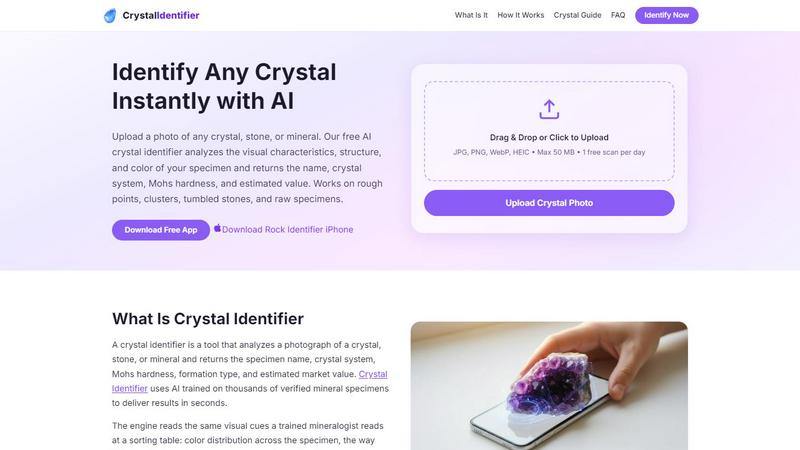
About Crystal Identifier
Crystal Identifier is a freemium AI tool that identifies crystals, gemstones, minerals, rocks, fossils, and stones from a single photograph. Upload an image, and the service returns a likely name along with reference details such as Mohs hardness, crystal system, common properties, formation type, and an estimated value range. This tool is built for collectors, students, teachers, lapidary hobbyists, and anyone sorting through unknown specimens who needs a quick, reliable first estimate. The AI engine reads the same visual cues a trained mineralogist would assess at a sorting table: color distribution across the specimen, the way light bends through transparent zones, the angle where crystal faces meet, and the texture of fracture surfaces. It accomplishes this from a single photograph in roughly four seconds. What sets Crystal Identifier apart is its ability to handle edge cases that stump casual observers. A purple chunk might be amethyst, but purple also appears in fluorite, charoite, sugilite, and lepidolite. The AI separates these by cross-referencing crystal habit, transparency gradient, and luster type. The platform also includes a blog with identification guides and comparison articles to help users distinguish similar-looking stones and learn terminology. Available on web, iOS, and Android, Crystal Identifier works at home, in the field, or in a shop. Results depend on photo quality, lighting, and visible features, so AI outputs should be verified with physical tests and expert references when accuracy matters. Estimated values are informational and can vary by locality, treatment, or size.
Features of Crystal Identifier
AI-Powered Visual Analysis
The core engine analyzes color saturation, transparency zones, crystal habit geometry, luster type, and surface texture from your uploaded photo. It compares these features against a verified reference dataset of thousands of mineral species to deliver a result in seconds. The AI handles rough points, clusters, tumbled stones, polished cabochons, geodes, and raw specimens with equal accuracy. This feature provides a strong first estimate that narrows down candidates before deeper testing.
Comprehensive Mineral Data
After identification, users receive a detailed results page including the mineral name, crystal system, Mohs hardness, formation environment, geographic origin, and an estimated value range. If the AI confidence is lower, it lists alternative candidates ranked by probability. This depth of information helps collectors label their collections accurately and gives students and teachers reliable reference data for classroom use without needing multiple reference books.
Multi-Category Support
Unlike tools limited to one type of specimen, Crystal Identifier supports crystals, gemstones, minerals, rocks, fossils, and stones from a single upload. Users can identify a quartz point, a fossilized shell, a piece of granite, and a river stone all on the same platform. This versatility makes it the only tool needed for anyone dealing with diverse geological specimens, from lapidary artists sorting rough material to educators preparing varied classroom examples.
Cross-Platform Availability
Crystal Identifier is available as a web app, an iOS app, and an Android app. This means users can identify specimens at home on a desktop, in the field using a smartphone, or in a shop with a tablet. The free tier offers one scan per day without requiring an account, making it accessible for casual users. The mobile apps support drag-and-drop or click-to-upload workflows, and accept JPG, PNG, WebP, and HEIC formats up to 50 MB.
Use Cases of Crystal Identifier
Building and Labeling a Personal Collection
Collectors often acquire specimens at gem shows, estate sales, or online marketplaces without guaranteed identification. Crystal Identifier allows them to upload a photo of each new piece, receive a likely name and key properties, and label their collection accurately. The tool helps distinguish similar-looking stones like amethyst versus fluorite, preventing mislabeling and ensuring the collection's integrity over time. Users can also verify marketplace listings before purchasing.
Preparing Classroom or Educational Materials
Teachers and students in geology, earth science, or mineralogy courses need quick, reliable identification for hands-on learning. Crystal Identifier enables a student to photograph an unknown specimen from a classroom kit and receive immediate feedback on its name, hardness, and formation environment. This accelerates the learning process by providing instant reference data, allowing more time for discussion and hands-on testing rather than manual lookup in textbooks.
Verifying Marketplace or Estate Sale Purchases
When buying crystals, gemstones, or minerals from online marketplaces or estate sales, buyers need to verify what they are getting. Crystal Identifier lets users upload a photo of a listing or an in-hand specimen to get a preliminary identification and estimated value range. This helps buyers avoid overpaying for common stones misrepresented as rare varieties, and gives sellers confidence in their listings before posting.
Narrowing Candidates for Scientific or Lapidary Testing
Lapidary hobbyists and serious collectors often perform physical tests like hardness scratch tests, specific gravity measurements, or refractive index checks. Crystal Identifier provides a strong first estimate that narrows down the candidate list from hundreds of possibilities to a handful. This saves significant time and effort by pointing the user toward the most likely species before they invest in destructive or time-consuming testing methods.
Frequently Asked Questions
How accurate is the AI crystal identification?
The AI provides a strong first estimate based on visual characteristics visible in a photograph, including color, crystal habit, luster, and transparency. It is trained on thousands of verified mineral specimens and delivers results in seconds. However, AI identification cannot measure physical properties like hardness, specific gravity, or refractive index from a photo. For critical applications such as gemstone certification or high-value purchases, results should be verified with hands-on testing by a certified gemologist and expert references.
What file types and sizes are supported for upload?
Crystal Identifier accepts JPG, PNG, WebP, and HEIC image formats. The maximum file size is 50 MB per upload. Free tier users get one scan per day, while premium users may have higher or unlimited scan limits. For best results, use natural light, a plain background, and show the crystal faces if visible. Mist the specimen with water if the surface looks dull, as a wet surface reveals color and grain detail that dry surfaces hide completely.
Can I identify rocks, fossils, and stones, or only crystals?
Yes, Crystal Identifier supports identification of crystals, gemstones, minerals, rocks, fossils, and stones from a single photo. The AI engine is tuned for each specific category, so you can upload a quartz point, a fossilized shell, a piece of granite, and a river stone all on the same platform. The web app offers separate identification tools for rocks and stones, each using the same core AI engine optimized for that category.
Is my data private and are my images stored?
Crystal Identifier processes your uploaded images to perform the identification and then provides results. For privacy details, users should review the platform's privacy policy. The free tier does not require an account, which minimizes data collection for casual users. Results depend on photo quality, lighting, and visible features, so the AI outputs should be treated as a preliminary estimate rather than a final determination, especially for valuable or scientifically significant specimens.
Pricing of Crystal Identifier
Crystal Identifier operates on a freemium model. The free tier provides one scan per day without requiring an account, making it accessible for casual users and quick checks. For users who need more frequent identifications or additional features, premium subscription plans are available through the web app and mobile apps on iOS and Android. Specific pricing details for premium tiers are listed within the application and may vary by platform and region. The free tier is ideal for collectors, students, and hobbyists who need occasional identification, while premium plans suit serious collectors, dealers, and educators who require higher volume or advanced capabilities.
Explore more in this category:
Similar to Crystal Identifier

GenogramLab
GenogramLab is an AI-powered online genogram maker that turns family descriptions into editable diagrams, helping you visualize family structures and

Free Gemini Omni
Create, remix, and edit cinematic AI videos online with Free Gemini Omni using text, image, audio, and video prompts.



amaze.directory
Find an AI tool by the job you need done, not the buzzword.