LLM Reference
LLM Reference curates and compares the best AI models and providers so tech leaders ship with the right pick, fast.
Visit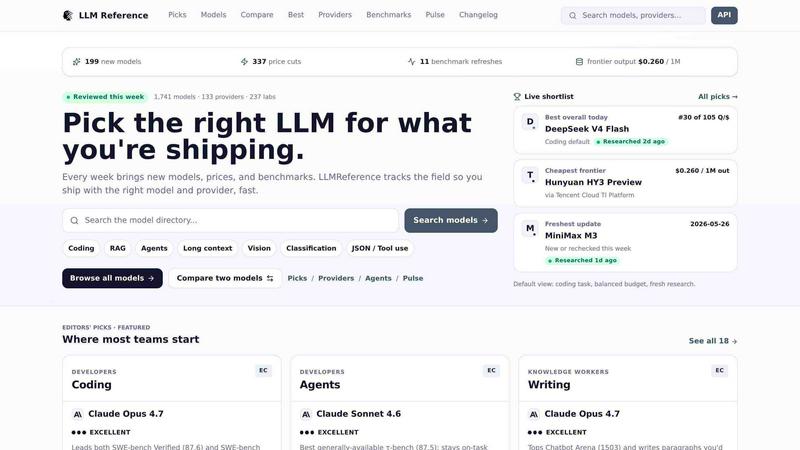
About LLM Reference
LLM Reference is a decision-support directory built for engineers and technology leaders who need to choose the right large language model (LLM) and provider in today's fast-moving AI landscape. It tracks over 1,800 language models from more than 140 providers and 247 research labs, with data refreshed daily to include new releases, verified price changes, and benchmark updates. The core value proposition is simple: stop wasting time hunting through scattered sources and start shipping with confidence. Whether you are building a coding assistant, an agentic workflow, a writing tool, or a research pipeline, LLM Reference gives you a single, trustworthy place to compare models side-by-side, see who offers the cheapest pricing for frontier output, and browse curated editors' picks for specific tasks like coding, agents, writing, research, image generation, and video creation. The site is designed for fast triage, allowing you to quickly identify the right model for your job, determine the most cost-effective provider, and get back to building. With a Pulse feed that highlights what changed this week, including new models, price cuts, and benchmark refreshes, LLM Reference keeps you informed without the noise. It is built by the Data Advantage project and updated daily, making it an essential resource for anyone who needs to stay current with the exploding LLM ecosystem. The platform offers a default view optimized for coding tasks with a balanced budget and fresh research, ensuring you always see the most relevant and up-to-date information first.
Features of LLM Reference
Comprehensive Model Directory
Access a meticulously curated directory of over 1,843 language models from 140 providers and 247 research labs. Each model entry includes detailed information on capabilities, pricing, benchmark scores, and provider details. The directory is searchable and filterable, allowing you to quickly narrow down options based on specific tasks like coding, RAG, agents, long context, vision, classification, and JSON or tool use. Data is refreshed daily to ensure you always have access to the latest releases and verified price changes.
Editors' Picks and Curated Boards
Navigate the model landscape with confidence using expert-curated selections for specific use cases. The platform features editors' picks for developers, knowledge workers, and creatives, with dedicated boards for coding, agents, writing, research, image generation, and video creation. Each pick includes a detailed rationale, highlighting key benchmark scores and real-world performance indicators. For example, Claude Fable 5 is recommended for coding with an 80.3% SWE-bench Pro score, while Veo 3.1 is the top pick for video generation with 30-second clips and 4K output.
Pulse Feed and Changelog
Stay informed about the rapidly evolving LLM ecosystem with the Pulse feed, which highlights weekly changes including new models, price cuts, and benchmark refreshes. The platform tracks 177 new models, 53 price cuts, and 368 benchmark refreshes in a typical week. The Changelog provides a detailed historical record of all updates, ensuring you never miss a critical development. This feature eliminates the need to monitor multiple sources, delivering a single, noise-free stream of relevant changes that impact your model selection decisions.
Side-by-Side Comparison Tool
Evaluate models and providers directly with the integrated comparison tool. You can compare two models across multiple dimensions, including benchmark performance, pricing per million tokens, and provider reliability. The tool surfaces critical metrics like frontier output pricing, showing the cheapest option available, such as Hunyuan HY3 Preview via Tencent Cloud TI Platform at $0.260 per 1M output tokens. This feature enables fast, data-driven decisions without switching between tabs or manually compiling data from disparate sources.
Use Cases of LLM Reference
Selecting the Best Coding Model for Production
Engineering teams building coding assistants or agentic workflows can use LLM Reference to identify the top-performing model for their specific needs. The platform's editors' picks highlight Claude Fable 5 as the best production coding pick, with an 80.3% SWE-bench Pro score and 96% SWE-bench Verified on Vals.ai. By comparing benchmark scores and pricing side-by-side, teams can select the most cost-effective model that meets their performance requirements, reducing evaluation time from days to minutes.
Optimizing Cost for High-Volume API Calls
Technology leaders managing budgets for AI-powered applications can leverage the frontier pricing data to minimize costs without sacrificing quality. The platform tracks verified price cuts and identifies the cheapest frontier output, currently Hunyuan HY3 Preview at $0.260 per 1M tokens. By monitoring the Pulse feed for price reductions and comparing provider pricing, teams can switch to more affordable options as they become available, potentially saving thousands of dollars monthly on high-volume API calls.
Researching and Comparing Benchmarks for Academic Projects
Researchers and data scientists can use the benchmark database to understand model performance across standardized tests. With over 1,200 scores tracked across major suites, the platform provides granular insights into model capabilities for specific tasks like summarization, translation, and data analysis. The ability to filter by lab and provider allows researchers to track the progress of specific research groups, such as the 247 labs currently active in the ecosystem, and identify emerging leaders in their field of interest.
Evaluating Providers for Enterprise Deployment
Enterprise architects evaluating multiple AI providers can use LLM Reference to consolidate their research into a single view. The platform lists 140 providers with detailed information on model offerings, pricing, and supported use cases. By browsing the providers section and comparing their portfolios, architects can identify which providers offer the best combination of models for their enterprise needs, whether that requires a single provider for consistency or a multi-provider strategy for specialized tasks like image generation with FLUX.2 Dev and video with Veo 3.1.
Frequently Asked Questions
How often is the data on LLM Reference updated?
The data is updated daily to ensure accuracy and relevance. The Pulse feed highlights weekly changes, including an average of 177 new models, 53 verified price cuts, and 368 benchmark refreshes. This daily cadence means you can rely on the platform for the most current information about the rapidly evolving LLM ecosystem, including new releases from providers like Anthropic, Google, and DeepSeek.
What is the default view on LLM Reference, and how is it determined?
The default view is optimized for coding tasks with a balanced budget and fresh research. This means the platform prioritizes models that offer strong coding benchmark performance at a reasonable price point, while also ensuring the data is based on the most recent research and updates. Users can easily adjust filters to match their specific priorities, such as focusing on cheapest frontier output or freshest updates.
How are the Editors' Picks selected and maintained?
Editors' Picks are curated by the Data Advantage team based on a combination of benchmark scores, real-world performance, pricing, and community feedback. Each pick includes a detailed rationale, such as Claude Fable 5's 80.3% SWE-bench Pro score for coding or Veo 3.1's best overall video quality with 30-second clips and native audio. These picks are reviewed and updated regularly as new models and benchmarks are released, ensuring they reflect the current state of the market.
Can I use LLM Reference to compare models from different providers directly?
Yes, the platform includes a dedicated comparison tool that allows you to compare two models side-by-side. This feature shows key metrics like benchmark performance, pricing per million tokens, and provider details. You can compare models like Claude Fable 5 versus GPT-5.5 or Claude Opus 4.8 versus its predecessor, making it easy to evaluate trade-offs between performance and cost across different providers and labs.
Similar to LLM Reference
Verla AI
AI academic assistant for writing, research, presentations, and coding
screenRIG
Signage and kiosk infrastructure for AI agents. Your agent publishes images, video, streams, web pages and apps to screens via one plugin.screenRIG is
Novastart
Novastart brings apps and files onto an infinite canvas where people and AI agents can work together.

AUTOMATER.ai
A tray helper for every AI coding tool: sessions, alerts and usage in one place

WidgIq
Provide an AI-powered customer support widget for your website

fit.
See any outfit on your own photo before you buy, and ask Aira, your AI stylist, what to wear from the clothes you own.
GetYouTubeTranscript
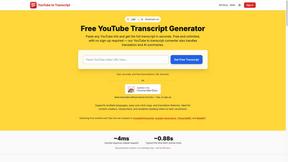
Free YouTube transcripts on the web, a Chrome extension, and an API + MCP server so AI assistants can read YouTube.