
Social Fetch API
A single API for clean, structured transcripts, metadata, and engagement data from 17 social platforms, built for reliable AI pipelines.
Visit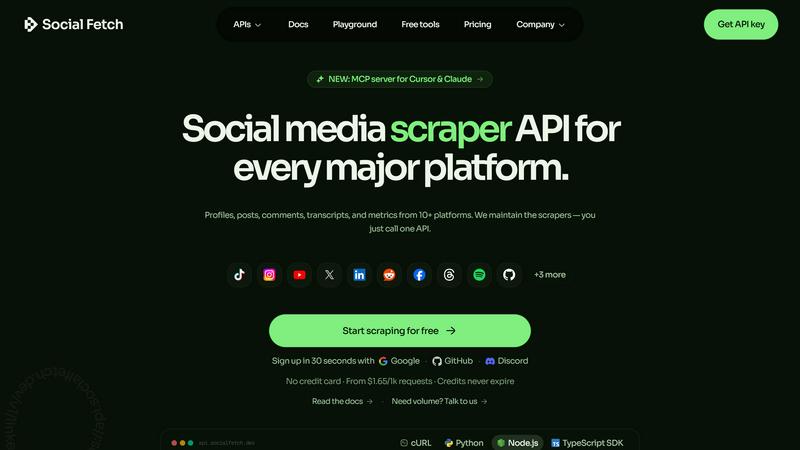
About Social Fetch API
Social Fetch API is a specialized social media scraper and transcript API designed for teams that treat social video as structured data. Instead of building and maintaining fragile headless browsers or custom caption parsers that break every time a platform redesigns its player, developers can use Social Fetch to reliably extract YouTube transcripts, TikTok metadata, captions, titles, descriptions, comment threads, likes, publish times, and related search results through simple REST JSON endpoints. This API serves research agents, summarization tools, content moderation pipelines, and insight dashboards that need live, normalized data from multiple social networks.
The core value proposition of Social Fetch is eliminating the maintenance burden of custom scrapers. The platform normalizes schemas across YouTube, TikTok, Instagram, Twitter, LinkedIn, and more, so one ingestion shape works across all networks with swapped platform parameters. This means no separate scrapers per site, no proxy management, and no dealing with platform rate limits. Social Fetch provides an MCP server and OpenAPI documentation to support both autonomous agent workflows and batch processing jobs. With parallel scraping capabilities, no per-minute limits, and credit-based billing that never expires, Social Fetch is built for production pipelines that require consistent, reliable data. The API delivers live public data on every request, with a unique requestId for traceability. Over 3.6 million lookups were processed in the last 30 days, and the service maintains 99.8% uptime. Social Fetch is designed for teams who want to ship features instead of glue code, letting them focus on building AI video pipelines, monitoring tools, and enrichment systems.
Features of Social Fetch API
Unified Schema Across Platforms
Social Fetch normalizes data structures across YouTube, TikTok, Instagram, Twitter, and LinkedIn into a consistent JSON format. This means your ingestion pipeline only needs to handle one schema shape, regardless of the source platform. You simply swap the platform parameter in your API call, and the same field names for followers, engagement metrics, bios, and profile details are returned. This eliminates the complexity of maintaining separate parsers and data mappers for each social network, dramatically reducing development time and technical debt.
Live Data with No Caching
Every API request to Social Fetch fetches live, current data directly from the source platforms. There are no stale caches or batch refreshes. This is critical for AI pipelines that require up-to-the-minute information for summarization, trend analysis, or content moderation. The API returns explicit lookup outcomes, so you always know whether the data is fresh and reliable. Social Fetch never charges for infrastructure failures, meaning if the API cannot deliver live data, you are not billed for that request.
Parallel Scraping Without Rate Limits
Social Fetch allows you to scrape multiple profiles, posts, or search results simultaneously without per-minute request limits. This parallel scraping capability is built into the infrastructure, so you can ingest entire creator catalogs or monitor dozens of topics concurrently. The credit-based billing model means you only pay for successful lookups, and credits never expire. This makes Social Fetch suitable for both small prototyping projects and large-scale production workloads that require high throughput.
Transcript and Caption Extraction
One of the standout features of Social Fetch is its ability to extract transcripts and captions from YouTube and TikTok videos. Instead of using fragile caption parsers that break when platforms update their players, Social Fetch provides reliable, structured text output that can be fed directly into LLMs for summarization, analysis, or transcription. This is particularly valuable for AI video pipelines that need to process spoken content, generate show notes, or build searchable archives of video libraries.
Use Cases of Social Fetch API
AI Video Content Summarization
Teams building AI agents that summarize video content can use Social Fetch to extract YouTube transcripts and TikTok captions alongside metadata like titles, descriptions, and publish dates. By feeding this structured data into an LLM, you can generate concise summaries, key takeaways, or even create searchable indexes of video libraries. The normalized schema ensures your summarization pipeline works consistently across platforms without custom parsing logic.
Social Media Monitoring and Trend Detection
Researchers and product teams can monitor topics, brands, or competitors across multiple social platforms using Social Fetch's profile scraping and hashtag search capabilities. The API returns engagement metrics like likes, comments, and follower counts, enabling trend detection dashboards that track growth over time. Because data is fetched live on every request, you can build real-time monitoring systems that alert on sudden spikes in activity or sentiment shifts.
Content Moderation and Safety Tools
Moderation teams can use Social Fetch to ingest comments, captions, and video metadata for automated content review. By pulling comment threads and transcripts through a single API, you can feed this data into NLP models that detect harmful language, spam, or policy violations. The consistent data structure means your moderation pipeline works identically whether the content comes from YouTube, TikTok, or Instagram, simplifying compliance workflows.
Creator and Influencer Analytics
Marketing teams and agencies can build analytics dashboards that track creator performance across platforms. Social Fetch provides profile data including follower counts, engagement rates, and bio information, as well as post-level metrics. By ingesting entire creator catalogs through parallel scraping, you can benchmark influencers, identify rising talent, and measure campaign ROI without maintaining separate scrapers for each network.
Frequently Asked Questions
What platforms does Social Fetch support?
Social Fetch currently supports YouTube, TikTok, Instagram, Twitter, and LinkedIn, with plans to add more platforms. Each platform has dedicated endpoints for profiles, posts, and search. The API normalizes data into a consistent schema, so your integration works the same way regardless of which platform you are querying. You can find the full list of supported endpoints and their schemas in the OpenAPI documentation.
How does the credit-based billing work?
Social Fetch uses a pay-as-you-go credit system. You receive 100 free credits upon signup with no credit card required. Each successful API lookup consumes one credit, and credits never expire. You are never charged for failed requests or infrastructure errors. Pricing starts at $1.65 per 1,000 credits at scale, making it cost-effective for both small prototypes and high-volume production pipelines. You can purchase credit packs as needed without committing to a subscription.
Can I use Social Fetch for real-time applications?
Yes, Social Fetch is designed for real-time use cases. Every API request fetches live data directly from the source platforms with no caching. Response times are typically under two seconds, and the API supports parallel requests without per-minute limits. This makes it suitable for real-time monitoring dashboards, live content moderation, and AI agents that need current information. The requestId returned on every response allows you to trace and audit individual lookups.
Is Social Fetch reliable for production pipelines?
Social Fetch maintains 99.8% uptime and has processed over 3.6 million lookups in the last 30 days. The platform handles scraper maintenance, proxy management, and platform changes so your team does not have to. Social Fetch never charges for infrastructure failures, and the explicit lookup outcomes ensure you can trust the data in production. With MCP server support and OpenAPI documentation, Social Fetch is built to integrate seamlessly into automated workflows and batch processing jobs.
Similar to Social Fetch API

RunwayAI
Independent AI video generator for text and image workflows with practical controls and API access.

Built2WinWeb AI SEO
Custom PHP websites, AI Indexing Pack ($599 one‑time), and WebAgentScan SaaS ($9/mo). MCP, A2A, llms.txt, full ownership.
TRam Studio
Build and operate auditable AI agents that automate real business workflows using your organization's knowledge and systems.




Postqued
Schedule and publish social content across 10 platforms with one dashboard, API, and MCP built for teams and AI agents.