
Agent to Agent Testing Platform vs SVG to 3D
Side-by-side comparison to help you choose the right AI tool.

Agent to Agent Testing Platform
TestMu AI validates AI agents for safety, accuracy, and reliability across all interaction modes.
Last updated: February 28, 2026
SVG to 3D
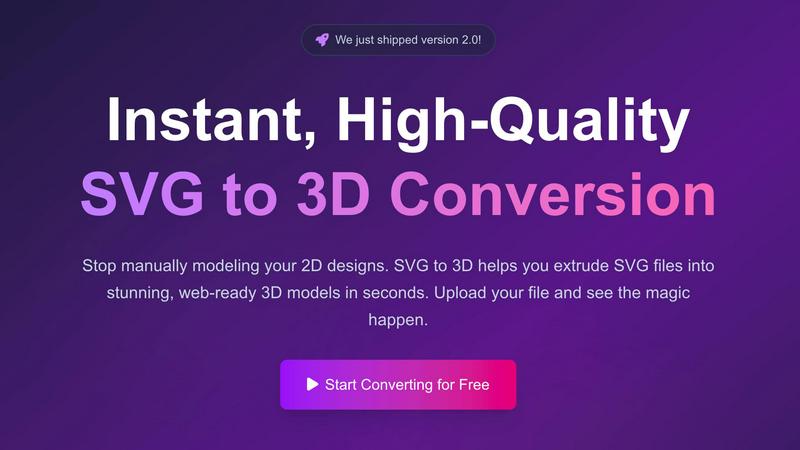
Instantly convert your SVG files into professional, web-ready 3D models.
Last updated: February 28, 2026
Visual Comparison
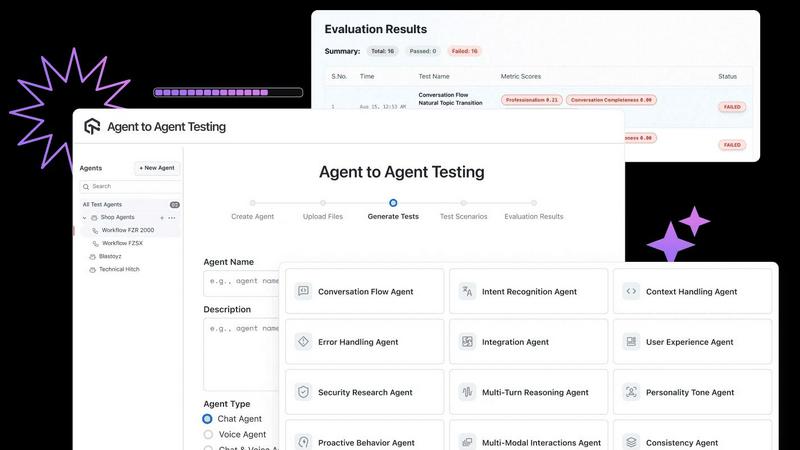
Agent to Agent Testing Platform
SVG to 3D
Feature Comparison
Agent to Agent Testing Platform
Autonomous Multi-Agent Test Generation
The platform employs a team of over 17 specialized AI agents to autonomously create diverse and complex test scenarios. These agents act as synthetic users, generating a vast array of conversational paths, edge cases, and long-tail interaction patterns that would be impractical to script manually. This ensures comprehensive coverage and uncovers failures that human testers are likely to miss.
True Multi-Modal Understanding and Testing
Go beyond text-based validation. The platform allows you to define requirements or upload PRDs (Product Requirement Documents) that include diverse inputs like images, audio, and video. It tests the AI agent's ability to understand and respond appropriately to these multi-modal inputs, accurately mirroring complex real-world user scenarios and interactions.
Diverse Persona-Based Testing
Simulate a wide spectrum of real human users by leveraging a library of diverse personas, such as an International Caller or a Digital Novice. This feature ensures your AI agent is tested against different user behaviors, accents, technical proficiencies, and needs, guaranteeing it performs effectively and empathetically for your entire user base, not just a homogeneous group.
Regression Testing with Intelligent Risk Scoring
Perform end-to-end regression testing for your AI agent with clear, prioritized insights. The platform provides a risk score that highlights potential areas of concern based on test results. This allows development and QA teams to quickly identify and prioritize critical issues, optimizing testing efforts and ensuring stability through continuous updates and deployments.
SVG to 3D
Instant Browser-Based Conversion
Experience the fastest SVG to 3D conversion available online. Our optimized algorithms process your files in seconds, not minutes, entirely within your web browser. Simply upload your SVG and watch as a detailed 3D model is generated instantly, with no software installation or lengthy waits required. This immediate feedback loop allows for rapid iteration and experimentation.
Advanced 3D Parameter Controls
Move far beyond basic extrusion. Our tool provides granular control over your model's properties. Precisely adjust the overall thickness, design complex custom bevels for rounded edges, and manipulate the model's scale and rotation. Every change is reflected in the real-time 3D preview, enabling you to craft the exact look and feel you desire before exporting.
Professional PBR Material System
Apply high-quality, physically-based rendering (PBR) materials to give your models realistic surfaces. Choose from a library of presets or customize properties like metalness and roughness. This advanced material system, typically found in professional 3D suites, allows you to create stunning, visually rich assets that stand out in any digital scene or presentation.
Developer-Optimized Export Formats
Export your creations in the formats you need for your workflow. We specialize in generating clean, lightweight, and web-optimized GLB/GLTF files that work seamlessly with Three.js, React Three Fiber, and Babylon.js. Additionally, export to OBJ or 3D-print-ready STL files with geometry that is intentionally clean and non-manifold error-free for reliable use in slicers and other applications.
Use Cases
Agent to Agent Testing Platform
Pre-Production Validation of Customer Service Bots
Before launching a new customer support chatbot or voice assistant, enterprises can use the platform to simulate thousands of customer interactions. This validates intent recognition, escalation logic, policy adherence (e.g., data privacy), and the overall conversational flow, ensuring the agent is ready for live deployment and reduces the risk of brand-damaging failures.
Ensuring Compliance and Reducing Toxicity/Bias
Organizations can proactively test AI agents for unintended bias, toxic responses, or compliance violations. By generating tests from diverse personas and checking for policy breaches, the platform helps mitigate legal, ethical, and reputational risks, ensuring AI interactions are safe, fair, and aligned with corporate and regulatory standards.
Continuous Testing for Agentic AI Pipelines
Integrate the platform into CI/CD pipelines for continuous validation of AI agents. Every time an agent's model, prompts, or knowledge base is updated, autonomous regression tests can run at scale to immediately detect regressions in performance, accuracy, or reasoning, maintaining high quality through rapid development cycles.
Performance Benchmarking Across Modalities
Compare and benchmark the performance of different AI agent models or configurations across chat, voice, and phone modalities. The platform provides detailed, consistent metrics on effectiveness, accuracy, empathy, and professionalism, enabling data-driven decisions to select and optimize the best agent for specific use cases.
SVG to 3D
Creating Interactive 3D Web Assets
Easily transform SVG logos, icons, and UI elements into engaging 3D models for the web. The tool's perfect SVG to GLB pipeline delivers assets that are ready to be integrated into interactive websites and experiences using popular JavaScript frameworks. This allows developers and designers to add depth and modern flair to digital projects without deep 3D expertise.
Preparing Designs for 3D Printing
Bridge the gap between digital design and physical creation. Convert vector art, logos, or custom shapes into ready-to-print 3D models. The clean STL export ensures your design is properly formatted for any slicer software, enabling hobbyists and professionals to bring their 2D concepts into the physical world without needing complex CAD modeling skills.
Enhancing UI/UX and Presentation Mockups
UI/UX designers can quickly add a new dimension to their mockups and client presentations. By converting Figma or Illustrator SVG exports into 3D models, you can demonstrate interactive components, logos, or interface elements with realistic lighting and depth. This creates more impactful, impressive presentations that effectively communicate design vision.
Rapid 3D Asset Prototyping
Speed up the early stages of any 3D project. Whether for game development, motion graphics, or architectural visualization, use SVG to 3D to quickly block out shapes, create simple 3D typography, or generate base models from vector drawings. It's an ideal tool for fast prototyping and concept development before refining models in more advanced software.
Overview
About Agent to Agent Testing Platform
Agent to Agent Testing Platform is the first AI-native quality assurance framework specifically engineered for the unique challenges of agentic AI systems. As AI agents—such as chatbots, voice assistants, and phone caller agents—become more autonomous and complex, traditional software testing methods are rendered obsolete. This platform provides a dedicated assurance layer that validates AI behavior in real-world, dynamic environments. It moves beyond simple prompt checks to evaluate full, multi-turn conversations across chat, voice, phone, and multimodal experiences. Designed for enterprises deploying AI at scale, its core value proposition is de-risking production rollouts by proactively uncovering long-tail failures, edge cases, and problematic interaction patterns that manual testing cannot reliably find. By leveraging a team of specialized AI agents to autonomously generate and execute thousands of synthetic user tests, it delivers actionable insights on critical metrics like bias, toxicity, hallucination, and policy compliance, ensuring AI agents perform accurately, reliably, and safely for all end-users.
About SVG to 3D
SVG to 3D is a specialized, browser-based tool designed to solve a singular, common frustration: the cumbersome process of converting 2D vector graphics into usable 3D models. It eliminates the need to launch complex, resource-intensive 3D modeling software like Blender or Cinema 4D for simple tasks such as extruding a logo, icon, or design element. The tool provides a fast, streamlined, and intuitive pathway from a flat SVG file to a fully-realized 3D asset, catering specifically to professionals who value speed and quality.
The primary value proposition lies in its instant, high-quality conversion and deep, browser-based control. Users can upload an SVG and within seconds have a 3D model they can fine-tune—adjusting extrusion thickness, adding sophisticated bevels, and applying realistic PBR materials—all with a live preview. It excels at producing clean, optimized geometry suitable for two key outputs: web-ready GLB/GLTF files for interactive experiences in frameworks like Three.js and React Three Fiber, and 3D-print-ready STL files for physical fabrication. Built with a privacy-first approach, processing often happens locally in your browser, ensuring your designs remain secure. Ultimately, SVG to 3D is the essential bridge for developers, web designers, UI/UX professionals, and 3D printing enthusiasts looking to add a third dimension to their work without the traditional learning curve or overhead.
Frequently Asked Questions
Agent to Agent Testing Platform FAQ
What makes Agent to Agent Testing different from traditional QA?
Traditional QA is built for deterministic, static software with predictable outputs. AI agents are probabilistic, dynamic, and their behavior evolves through conversation. This platform is AI-native, using other AI agents to test these non-linear, multi-turn interactions for nuances like reasoning, tone, and context-handling that scripted tests cannot evaluate.
What types of AI agents can be tested with this platform?
The platform is designed to test a wide range of AI-powered conversational agents. This includes text-based chatbots, voice assistants (like IVR systems), phone caller agents, and hybrid agents that operate across multiple modalities (text, voice, image). It validates the full agentic system, not just the underlying LLM.
How does the platform generate relevant test scenarios?
It uses a suite of specialized AI agents (e.g., a Personality Tone Agent, Data Privacy Agent) to autonomously create test scenarios. You can also access a pre-built library of hundreds of scenarios or create custom ones by defining requirements or uploading documents (PRDs), ensuring tests are tailored to your agent's specific functions and expected user interactions.
Can I integrate this testing into my existing development workflow?
Yes. The platform seamlessly integrates with TestMu AI's HyperExecute for large-scale cloud execution. This allows you to incorporate autonomous AI agent testing into your CI/CD pipelines, triggering test suites at scale with minimal setup and receiving actionable, detailed evaluation reports within minutes to inform development decisions.
SVG to 3D FAQ
What file formats can I export my 3D model to?
SVG to 3D supports exporting your converted models in multiple industry-standard formats. You can download your creation as a GLB or GLTF file, which is optimal for web use and real-time applications. For broader 3D software compatibility, OBJ export is available. For 3D printing, you can export directly as an STL file, ready for your slicer software.
Is my data secure and private when I use this tool?
Yes, privacy and security are fundamental to our tool. Whenever possible, the entire conversion process is handled locally within your web browser. This means your SVG files and the resulting 3D models are never uploaded to our servers, ensuring your proprietary designs and work remain completely confidential on your own machine.
Do I need to install any software to use SVG to 3D?
No installation is required. SVG to 3D is a fully web-based application that runs directly in your modern browser (like Chrome, Firefox, or Edge). You can access it instantly from any device with an internet connection, making it incredibly convenient and accessible without consuming disk space with software downloads.
What are the limitations on the SVG files I can upload?
The primary limitation is file size, with a maximum upload size of 5 MB per SVG file. The tool supports standard SVG elements including paths, shapes, and strokes. For best results, ensure your SVG file is well-formed and uses solid shapes for extrusion, as overly complex or open paths may not convert as intended.
Alternatives
Agent to Agent Testing Platform Alternatives
Agent to Agent Testing Platform is a specialized AI-native quality assurance framework for validating autonomous AI agents. It belongs to the AI Assistants and agent testing category, providing a dedicated layer to evaluate multi-turn conversations across chat, voice, phone, and multimodal systems before production. Users may explore alternatives for various reasons, such as budget constraints, specific feature requirements not covered, or a need for a platform that integrates differently with their existing tech stack. The search often stems from a need to find the right balance of depth, scalability, and cost for their unique agentic AI validation challenges. When evaluating alternatives, prioritize solutions that offer comprehensive, multi-turn conversation testing beyond simple prompt checks. Look for capabilities in autonomous test generation, validation of security and compliance policies, and the ability to simulate realistic user interactions at scale to uncover edge cases and long-tail failures effectively.
SVG to 3D Alternatives
SVG to 3D is a specialized AI-powered tool designed to streamline the conversion of 2D vector graphics into usable 3D models. It belongs to a growing category of web-based design and development utilities that prioritize speed and accessibility over complex, feature-heavy software. Users often seek alternatives for various reasons, including budget constraints, the need for different export formats, or a requirement for more advanced modeling capabilities not covered by a focused tool. When evaluating other options, it's crucial to consider your primary use case. Key factors include the supported 3D file formats for your pipeline, the level of customization for extrusions and materials, and whether the platform is web-based or requires software installation. The ideal alternative should match your specific workflow, whether for web development, 3D printing, or rapid prototyping. ---
FAQ_SEPARATOR---
[
{"question": "What is SVG to 3D?", "answer": "SVG to 3D is a tool that quickly converts 2D SVG vector graphics into high-quality 3D models, streamlining a process that typically requires complex 3D software."},
{"question": "Who is SVG to 3D for?", "answer": "It is built for web developers, designers, and 3D printing enthusiasts who need a fast, browser-based solution to create 3D assets from 2D designs."},
{"question": "What are the main features of SVG to 3D?", "answer": "Key features include one-click GLB export for web projects, 3D-print ready STL files, and in-browser controls for fine-tuning thickness, bevels, and PBR materials."},
{"question": "Why choose SVG to 3D?", "answer": "Choose SVG to 3D for its speed and simplicity, specifically for turning logos or icons into web-ready 3D models or printable files without opening heavyweight 3D software."}
]