
Prefactor vs Prompt Builder
Side-by-side comparison to help you choose the right AI tool.

Prefactor
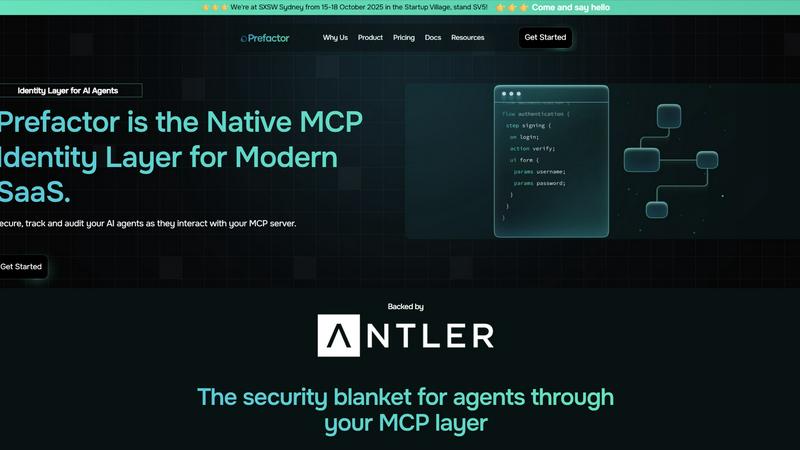
Prefactor governs and audits AI agents for secure, compliant production in regulated industries.
Last updated: March 1, 2026

Prompt Builder
Prompt Builder instantly crafts and refines AI prompts for any model, saving you time and boosting results.
Last updated: April 13, 2026
Visual Comparison
Prefactor
Prompt Builder
Feature Comparison
Prefactor
Real-Time Agent Monitoring & Dashboard
Gain complete operational visibility across your entire agent infrastructure from a unified dashboard. Track every active agent in real-time, monitor what tools and data they are accessing, and identify emerging issues or failures before they escalate into major incidents. This feature provides the actionable insights needed for reliable production operations, moving teams from flying blind to being fully informed.
Compliance-Ready Audit Trails
Move beyond cryptic API logs. Prefactor translates every agent action into clear, business-context audit trails that stakeholders and compliance officers can understand. When asked "what did the agent do?", you can provide definitive, audit-ready answers and generate comprehensive reports in minutes, not weeks, ensuring your deployments can withstand rigorous regulatory scrutiny.
Identity-First Access Control
Apply proven human identity governance principles to your AI agents. Every agent receives a unique, first-class identity. Every action is authenticated, and every permission is explicitly scoped via policy-as-code. This enables dynamic client registration, delegated access, and fine-grained control, ensuring agents only access the resources they are authorized to use.
Emergency Kill Switches & Cost Tracking
Maintain ultimate control with the ability to instantly deactivate any agent in case of unexpected behavior or security concerns. Coupled with detailed cost tracking across compute providers, this feature allows organizations to not only manage risk but also identify expensive operational patterns and optimize agent spending for greater efficiency and cost predictability.
Prompt Builder
Prompt Generator
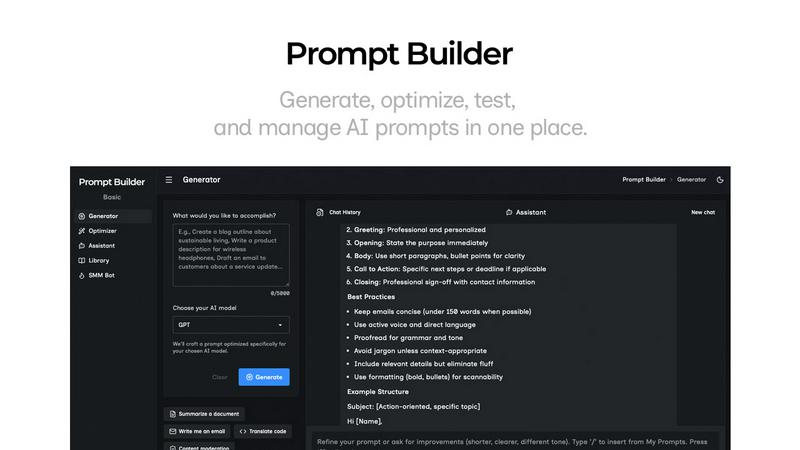
The Prompt Generator is your starting point for crafting exceptional prompts. Simply describe your task or idea in natural language and select your target AI model (e.g., Gemini, Claude, GPT-4). The engine then creates a professional-grade, model-tuned prompt draft that incorporates optimal structure, constraints, and output formatting specific to that model. This foundational feature ensures you begin with a strong, tailored foundation rather than a generic template, dramatically increasing the likelihood of a successful output on the first attempt.
Prompt Assistant & Chat Workspace
This integrated chat environment allows you to test and refine prompts without ever leaving Prompt Builder. Run your generated or saved prompts directly within the Assistant, which supports a wide range of models including Grok, Gemini, GPT, and DeepSeek. Iterate with follow-up questions, adjust instructions on the fly, and see real-time results. The chat history is preserved, enabling fast iterations and preventing the loss of successful dialogue paths. It consolidates testing and refinement into a single, organized workspace.
Prompt Optimizer
The Optimizer tool elevates existing prompts to their highest potential. Paste any prompt—whether from an external source or your own Library—and the Optimizer will analyze and enhance it. It provides structured improvements focused on clarity, adding necessary constraints, defining output formats, and suggesting examples. Each optimization is saved in a history log, and you can pin favorite versions. With one click, you can run the optimized prompt in the Assistant to immediately validate the improvements.
Prompt Library & Community Templates
Build a personal repository of your most effective prompts with the Prompt Library. Save, pin, categorize, and search your curated collection for easy reuse across projects and teams. Beyond your private library, explore a growing collection of Community Prompts and templates contributed by other users. This feature transforms isolated successes into a scalable, organizational asset, ensuring you never lose a "good version" and can continuously build upon proven prompt strategies.
Use Cases
Prefactor
Scaling AI Agents in Regulated Finance
A Fortune 500 financial institution can move from isolated agent pilots to governed production deployments. Prefactor provides the auditable identity, real-time monitoring, and compliance-ready reporting required to satisfy internal security and external regulators, turning a governance blocker into a competitive advantage.
Managing Multi-Agent Workflows in Healthcare
A healthcare technology company can safely deploy autonomous agents that handle sensitive patient data. By enforcing strict, auditable access controls and providing clear audit trails for every action, Prefactor ensures compliance with HIPAA and other regulations while enabling innovative AI-assisted workflows.
Governing Autonomous Operations in Critical Infrastructure
A mining or energy company can implement AI agents for operational optimization. Prefactor's robust control plane, built for high-stakes environments, offers the emergency kill switches and unwavering auditability needed to deploy autonomous systems where failure is not an option, ensuring safety and accountability.
Unifying Visibility Across AI Frameworks
A product engineering team using a mix of LangChain, CrewAI, and custom agent frameworks can centralize management. Prefactor's framework-agnostic integration brings all agents under one dashboard, eliminating siloed visibility and providing consistent governance, monitoring, and cost tracking regardless of the underlying technology.
Prompt Builder
Content Creation & Marketing
Writers and marketers can rapidly generate and refine prompts for blog outlines, marketing copy, social media posts (via the dedicated SMM Bot), and product descriptions. The ability to tune prompts for different tones and platforms—and save successful formulas—turns a creative brainstorming session into a repeatable, efficient content production pipeline, ensuring brand consistency and quality.
Software Development & Technical Writing
Developers and technical writers use Prompt Builder to create precise prompts for code generation, debugging, documentation, and API explanation. The model-specific tuning ensures that prompts leverage each AI's strengths (e.g., Claude's long-context reasoning or GPT's code proficiency), leading to more accurate, usable code snippets and technical explanations with fewer errors and revisions.
Research & Data Analysis
Academics, analysts, and students can craft sophisticated prompts for literature reviews, data summarization, hypothesis generation, and complex querying. The iterative chat workspace allows for deep dives into topics, following chains of thought, and refining questions based on initial outputs. Saving these research-focused prompts creates a valuable knowledge base for ongoing projects.
Business Operations & Productivity
Professionals across functions—from HR crafting job descriptions to sales generating outreach emails—can systematize their AI interactions. Prompt Builder allows teams to develop, optimize, and share standardized prompts for common operational tasks, ensuring efficiency, reducing prompt engineering overhead for non-experts, and maintaining a high standard of output across the organization.
Overview
About Prefactor
Prefactor is the essential control plane for AI agents, designed to bridge the critical gap between promising proof-of-concept demos and secure, compliant production deployments. It provides a centralized governance layer for organizations running multiple AI agents, particularly within complex, regulated industries like financial services, healthcare, and mining. The platform addresses the fundamental challenge of managing autonomous software entities by treating every agent as a first-class citizen with a unique, auditable identity. This identity-first approach allows security, product, engineering, and compliance teams to align around a single source of truth. By automating permissions through policy-as-code and integrating seamlessly into CI/CD pipelines, Prefactor enables teams to govern at scale without sacrificing speed. With its emphasis on real-time visibility, business-context audit trails, and SOC 2-ready, interoperable security (OAuth/OIDC), Prefactor transforms agent management from a fragmented, manual burden into a streamlined, trustworthy foundation for innovation.
About Prompt Builder
Prompt Builder is a dedicated workspace designed to transform the art and science of prompt engineering from a time-consuming chore into a streamlined, efficient process. It serves as a central hub for professionals, creators, and teams who rely on multiple AI models—such as GPT, Claude, Gemini, Llama, and Mistral—to generate high-quality outputs. The core value proposition is simple: stop rewriting prompts and start getting consistent, superior results. Instead of manually crafting and adapting instructions for each unique model, users describe their task in plain English. Prompt Builder then generates a model-optimized draft, provides a chat environment for iterative refinement, and offers robust tools for saving, organizing, and reusing perfected prompts. This eliminates the friction of jumping between applications, losing valuable versions in endless chat threads, and wasting tokens on subpar retries. It’s the definitive solution for turning a fleeting idea into a reliable, production-ready prompt in seconds.
Frequently Asked Questions
Prefactor FAQ
What is an AI Agent Control Plane?
An AI Agent Control Plane is a dedicated governance layer that manages the security, operations, and compliance of autonomous AI agents. Think of it like an identity and access management (IAM) system or a Kubernetes control plane, but specifically designed for AI agents. It provides centralized oversight for identity, permissions, monitoring, and auditing.
How does Prefactor handle agent identity?
Prefactor assigns a first-class, unique identity to every AI agent, similar to how employees get user accounts. This identity is used to authenticate every action the agent takes. Access permissions for these identities are managed through policy-as-code, allowing for automated, scalable, and auditable governance directly within your development pipelines.
Is Prefactor built for specific AI frameworks?
No, Prefactor is designed to be framework-agnostic. It offers integrations and SDKs that work with popular frameworks like LangChain, CrewAI, and AutoGen, as well as custom agent builds. This allows you to govern your entire fleet of agents from a single platform, regardless of how they were developed.
What makes Prefactor suitable for regulated industries?
Prefactor is built from the ground up for regulated environments. It provides SOC 2-ready security foundations, interoperable OAuth/OIDC standards, and—critically—audit trails that translate technical events into clear business language for compliance teams. This design ensures deployments meet stringent security and auditability requirements.
Prompt Builder FAQ
What AI models does Prompt Builder support?
Prompt Builder is designed as a universal prompt workspace. It supports prompt generation and optimization for a wide array of leading models including OpenAI's GPT series, Anthropic's Claude, Google's Gemini, Meta's Llama, Mistral AI, DeepSeek, xAI's Grok, Perplexity, and Cohere. The integrated Assistant allows you to run and chat with many of these models directly within the platform.
How does the free plan work?
The free plan offers full access to the Prompt Generator, Optimizer, and Library features. It includes 25 Assistant requests per month, allowing you to test and run prompts within the platform using supported models at no cost and without requiring a credit card. This is ideal for individuals exploring the tool or with light usage needs.
Can I use prompts created in Prompt Builder elsewhere?
Absolutely. Prompts you create, refine, and save in your Library are yours to use. You can copy any prompt and use it in your preferred AI chat interface (like ChatGPT or Claude's website), in automation workflows via API, or share them with your team. Prompt Builder enhances the prompt's quality and structure, but you own the final output.
How does the model-specific tuning work?
When you select a target model in the Prompt Generator, the system applies best practices and known structural preferences for that specific model. This goes beyond simple keyword substitution; it adjusts the prompt's framing, instruction placement, constraint formatting, and desired output style to align with how that particular model has been trained to respond most effectively, leading to higher quality and more reliable results.
Alternatives
Prefactor Alternatives
Prefactor is a control plane designed for governing AI agents in regulated industries, ensuring visibility, compliance, and secure identity management. Organizations may explore alternatives for various reasons, such as budget constraints, specific feature gaps, or a need for a solution integrated within a broader platform ecosystem. When evaluating other options, it's crucial to assess their ability to provide auditable, identity-first control for autonomous agents. Key considerations include the depth of real-time monitoring, the clarity of compliance-ready audit trails, and the robustness of security frameworks like SOC 2. The ideal solution should seamlessly integrate governance into existing engineering workflows. Ultimately, the right choice aligns technical capabilities with business requirements for risk management and regulatory adherence. The focus should remain on establishing a trustworthy, scalable layer of control as AI agents move from concept to critical production roles.
Prompt Builder Alternatives
Prompt Builder is a dedicated prompt engineering workspace designed to streamline the entire lifecycle of AI prompts, from initial idea to deployment. It falls within the category of AI Assistants, specifically focusing on the craft and management of instructions for large language models. Users often seek alternatives for various reasons, including budget constraints, the need for different feature sets, or integration with a specific platform or workflow. When evaluating other solutions, it's crucial to consider your core requirements. Key factors include the range of supported AI models, the sophistication of testing and optimization tools, and the ability to organize and reuse prompts effectively. The ideal platform should enhance your productivity without adding complexity, turning prompt engineering from a chore into a strategic advantage.