
Agent to Agent Testing Platform vs Prefactor
Side-by-side comparison to help you choose the right AI tool.

Agent to Agent Testing Platform
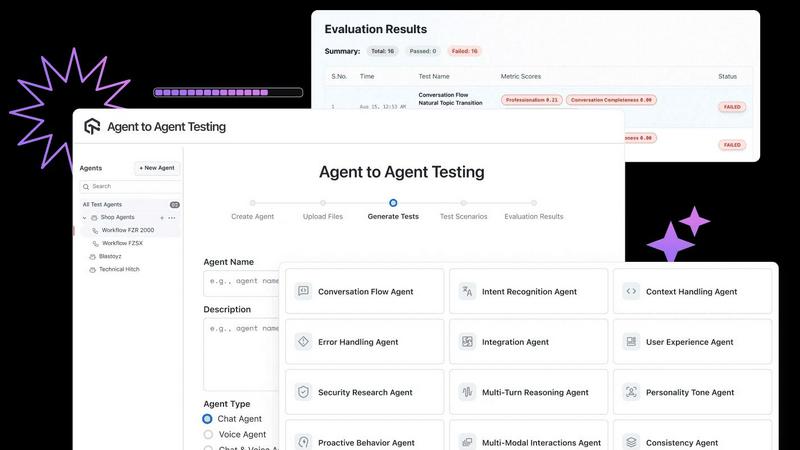
TestMu AI validates AI agents for safety, accuracy, and reliability across all interaction modes.
Last updated: February 28, 2026

Prefactor
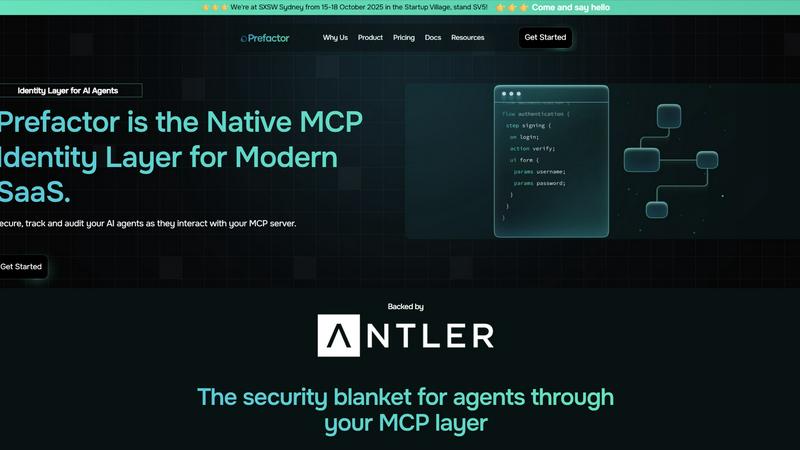
Prefactor governs and audits AI agents for secure, compliant production in regulated industries.
Last updated: March 1, 2026
Visual Comparison
Agent to Agent Testing Platform
Prefactor
Feature Comparison
Agent to Agent Testing Platform
Autonomous Multi-Agent Test Generation
The platform employs a team of over 17 specialized AI agents to autonomously create diverse and complex test scenarios. These agents act as synthetic users, generating a vast array of conversational paths, edge cases, and long-tail interaction patterns that would be impractical to script manually. This ensures comprehensive coverage and uncovers failures that human testers are likely to miss.
True Multi-Modal Understanding and Testing
Go beyond text-based validation. The platform allows you to define requirements or upload PRDs (Product Requirement Documents) that include diverse inputs like images, audio, and video. It tests the AI agent's ability to understand and respond appropriately to these multi-modal inputs, accurately mirroring complex real-world user scenarios and interactions.
Diverse Persona-Based Testing
Simulate a wide spectrum of real human users by leveraging a library of diverse personas, such as an International Caller or a Digital Novice. This feature ensures your AI agent is tested against different user behaviors, accents, technical proficiencies, and needs, guaranteeing it performs effectively and empathetically for your entire user base, not just a homogeneous group.
Regression Testing with Intelligent Risk Scoring
Perform end-to-end regression testing for your AI agent with clear, prioritized insights. The platform provides a risk score that highlights potential areas of concern based on test results. This allows development and QA teams to quickly identify and prioritize critical issues, optimizing testing efforts and ensuring stability through continuous updates and deployments.
Prefactor
Real-Time Agent Monitoring & Dashboard
Gain complete operational visibility across your entire agent infrastructure from a unified dashboard. Track every active agent in real-time, monitor what tools and data they are accessing, and identify emerging issues or failures before they escalate into major incidents. This feature provides the actionable insights needed for reliable production operations, moving teams from flying blind to being fully informed.
Compliance-Ready Audit Trails
Move beyond cryptic API logs. Prefactor translates every agent action into clear, business-context audit trails that stakeholders and compliance officers can understand. When asked "what did the agent do?", you can provide definitive, audit-ready answers and generate comprehensive reports in minutes, not weeks, ensuring your deployments can withstand rigorous regulatory scrutiny.
Identity-First Access Control
Apply proven human identity governance principles to your AI agents. Every agent receives a unique, first-class identity. Every action is authenticated, and every permission is explicitly scoped via policy-as-code. This enables dynamic client registration, delegated access, and fine-grained control, ensuring agents only access the resources they are authorized to use.
Emergency Kill Switches & Cost Tracking
Maintain ultimate control with the ability to instantly deactivate any agent in case of unexpected behavior or security concerns. Coupled with detailed cost tracking across compute providers, this feature allows organizations to not only manage risk but also identify expensive operational patterns and optimize agent spending for greater efficiency and cost predictability.
Use Cases
Agent to Agent Testing Platform
Pre-Production Validation of Customer Service Bots
Before launching a new customer support chatbot or voice assistant, enterprises can use the platform to simulate thousands of customer interactions. This validates intent recognition, escalation logic, policy adherence (e.g., data privacy), and the overall conversational flow, ensuring the agent is ready for live deployment and reduces the risk of brand-damaging failures.
Ensuring Compliance and Reducing Toxicity/Bias
Organizations can proactively test AI agents for unintended bias, toxic responses, or compliance violations. By generating tests from diverse personas and checking for policy breaches, the platform helps mitigate legal, ethical, and reputational risks, ensuring AI interactions are safe, fair, and aligned with corporate and regulatory standards.
Continuous Testing for Agentic AI Pipelines
Integrate the platform into CI/CD pipelines for continuous validation of AI agents. Every time an agent's model, prompts, or knowledge base is updated, autonomous regression tests can run at scale to immediately detect regressions in performance, accuracy, or reasoning, maintaining high quality through rapid development cycles.
Performance Benchmarking Across Modalities
Compare and benchmark the performance of different AI agent models or configurations across chat, voice, and phone modalities. The platform provides detailed, consistent metrics on effectiveness, accuracy, empathy, and professionalism, enabling data-driven decisions to select and optimize the best agent for specific use cases.
Prefactor
Scaling AI Agents in Regulated Finance
A Fortune 500 financial institution can move from isolated agent pilots to governed production deployments. Prefactor provides the auditable identity, real-time monitoring, and compliance-ready reporting required to satisfy internal security and external regulators, turning a governance blocker into a competitive advantage.
Managing Multi-Agent Workflows in Healthcare
A healthcare technology company can safely deploy autonomous agents that handle sensitive patient data. By enforcing strict, auditable access controls and providing clear audit trails for every action, Prefactor ensures compliance with HIPAA and other regulations while enabling innovative AI-assisted workflows.
Governing Autonomous Operations in Critical Infrastructure
A mining or energy company can implement AI agents for operational optimization. Prefactor's robust control plane, built for high-stakes environments, offers the emergency kill switches and unwavering auditability needed to deploy autonomous systems where failure is not an option, ensuring safety and accountability.
Unifying Visibility Across AI Frameworks
A product engineering team using a mix of LangChain, CrewAI, and custom agent frameworks can centralize management. Prefactor's framework-agnostic integration brings all agents under one dashboard, eliminating siloed visibility and providing consistent governance, monitoring, and cost tracking regardless of the underlying technology.
Overview
About Agent to Agent Testing Platform
Agent to Agent Testing Platform is the first AI-native quality assurance framework specifically engineered for the unique challenges of agentic AI systems. As AI agents—such as chatbots, voice assistants, and phone caller agents—become more autonomous and complex, traditional software testing methods are rendered obsolete. This platform provides a dedicated assurance layer that validates AI behavior in real-world, dynamic environments. It moves beyond simple prompt checks to evaluate full, multi-turn conversations across chat, voice, phone, and multimodal experiences. Designed for enterprises deploying AI at scale, its core value proposition is de-risking production rollouts by proactively uncovering long-tail failures, edge cases, and problematic interaction patterns that manual testing cannot reliably find. By leveraging a team of specialized AI agents to autonomously generate and execute thousands of synthetic user tests, it delivers actionable insights on critical metrics like bias, toxicity, hallucination, and policy compliance, ensuring AI agents perform accurately, reliably, and safely for all end-users.
About Prefactor
Prefactor is the essential control plane for AI agents, designed to bridge the critical gap between promising proof-of-concept demos and secure, compliant production deployments. It provides a centralized governance layer for organizations running multiple AI agents, particularly within complex, regulated industries like financial services, healthcare, and mining. The platform addresses the fundamental challenge of managing autonomous software entities by treating every agent as a first-class citizen with a unique, auditable identity. This identity-first approach allows security, product, engineering, and compliance teams to align around a single source of truth. By automating permissions through policy-as-code and integrating seamlessly into CI/CD pipelines, Prefactor enables teams to govern at scale without sacrificing speed. With its emphasis on real-time visibility, business-context audit trails, and SOC 2-ready, interoperable security (OAuth/OIDC), Prefactor transforms agent management from a fragmented, manual burden into a streamlined, trustworthy foundation for innovation.
Frequently Asked Questions
Agent to Agent Testing Platform FAQ
What makes Agent to Agent Testing different from traditional QA?
Traditional QA is built for deterministic, static software with predictable outputs. AI agents are probabilistic, dynamic, and their behavior evolves through conversation. This platform is AI-native, using other AI agents to test these non-linear, multi-turn interactions for nuances like reasoning, tone, and context-handling that scripted tests cannot evaluate.
What types of AI agents can be tested with this platform?
The platform is designed to test a wide range of AI-powered conversational agents. This includes text-based chatbots, voice assistants (like IVR systems), phone caller agents, and hybrid agents that operate across multiple modalities (text, voice, image). It validates the full agentic system, not just the underlying LLM.
How does the platform generate relevant test scenarios?
It uses a suite of specialized AI agents (e.g., a Personality Tone Agent, Data Privacy Agent) to autonomously create test scenarios. You can also access a pre-built library of hundreds of scenarios or create custom ones by defining requirements or uploading documents (PRDs), ensuring tests are tailored to your agent's specific functions and expected user interactions.
Can I integrate this testing into my existing development workflow?
Yes. The platform seamlessly integrates with TestMu AI's HyperExecute for large-scale cloud execution. This allows you to incorporate autonomous AI agent testing into your CI/CD pipelines, triggering test suites at scale with minimal setup and receiving actionable, detailed evaluation reports within minutes to inform development decisions.
Prefactor FAQ
What is an AI Agent Control Plane?
An AI Agent Control Plane is a dedicated governance layer that manages the security, operations, and compliance of autonomous AI agents. Think of it like an identity and access management (IAM) system or a Kubernetes control plane, but specifically designed for AI agents. It provides centralized oversight for identity, permissions, monitoring, and auditing.
How does Prefactor handle agent identity?
Prefactor assigns a first-class, unique identity to every AI agent, similar to how employees get user accounts. This identity is used to authenticate every action the agent takes. Access permissions for these identities are managed through policy-as-code, allowing for automated, scalable, and auditable governance directly within your development pipelines.
Is Prefactor built for specific AI frameworks?
No, Prefactor is designed to be framework-agnostic. It offers integrations and SDKs that work with popular frameworks like LangChain, CrewAI, and AutoGen, as well as custom agent builds. This allows you to govern your entire fleet of agents from a single platform, regardless of how they were developed.
What makes Prefactor suitable for regulated industries?
Prefactor is built from the ground up for regulated environments. It provides SOC 2-ready security foundations, interoperable OAuth/OIDC standards, and—critically—audit trails that translate technical events into clear business language for compliance teams. This design ensures deployments meet stringent security and auditability requirements.
Alternatives
Agent to Agent Testing Platform Alternatives
Agent to Agent Testing Platform is a specialized AI-native quality assurance framework for validating autonomous AI agents. It belongs to the AI Assistants and agent testing category, providing a dedicated layer to evaluate multi-turn conversations across chat, voice, phone, and multimodal systems before production. Users may explore alternatives for various reasons, such as budget constraints, specific feature requirements not covered, or a need for a platform that integrates differently with their existing tech stack. The search often stems from a need to find the right balance of depth, scalability, and cost for their unique agentic AI validation challenges. When evaluating alternatives, prioritize solutions that offer comprehensive, multi-turn conversation testing beyond simple prompt checks. Look for capabilities in autonomous test generation, validation of security and compliance policies, and the ability to simulate realistic user interactions at scale to uncover edge cases and long-tail failures effectively.
Prefactor Alternatives
Prefactor is a control plane designed for governing AI agents in regulated industries, ensuring visibility, compliance, and secure identity management. Organizations may explore alternatives for various reasons, such as budget constraints, specific feature gaps, or a need for a solution integrated within a broader platform ecosystem. When evaluating other options, it's crucial to assess their ability to provide auditable, identity-first control for autonomous agents. Key considerations include the depth of real-time monitoring, the clarity of compliance-ready audit trails, and the robustness of security frameworks like SOC 2. The ideal solution should seamlessly integrate governance into existing engineering workflows. Ultimately, the right choice aligns technical capabilities with business requirements for risk management and regulatory adherence. The focus should remain on establishing a trustworthy, scalable layer of control as AI agents move from concept to critical production roles.