
Dreamflow vs Miget
Side-by-side comparison to help you choose the right AI tool.
Dreamflow
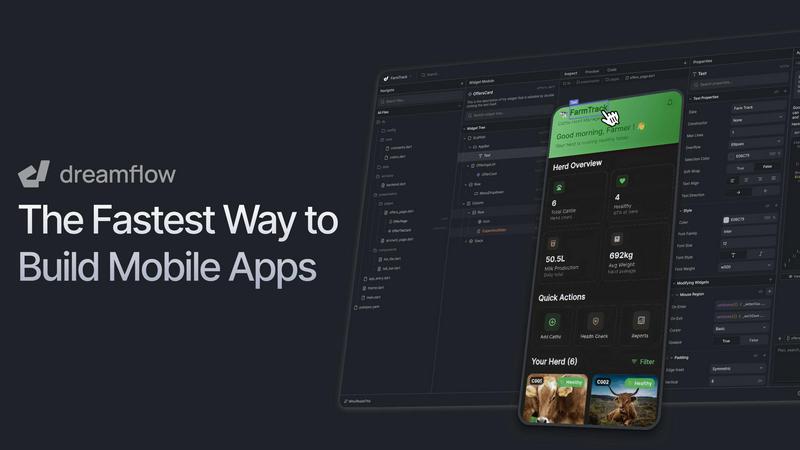
Dreamflow is a visual AI builder that syncs your prompts, canvas, and code for production apps.
Last updated: March 1, 2026

Miget
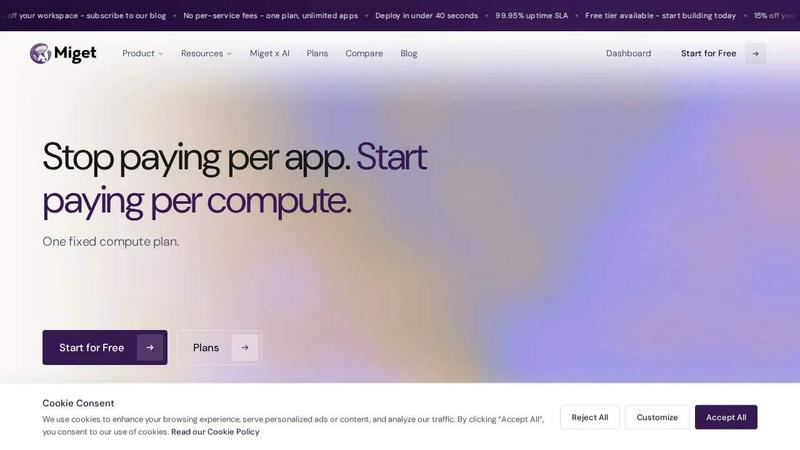
Miget lets you deploy unlimited applications and services on a single flat-rate plan, eliminating per-service fees and surprise costs.
Last updated: April 13, 2026
Visual Comparison
Dreamflow
Miget
Feature Comparison
Dreamflow
Tri-Surface Editing
Dreamflow's core innovation is its synchronized tri-surface environment. You can switch seamlessly between an AI agent you prompt in natural language, a visual drag-and-drop canvas, and a full Flutter code editor. Every change made on one surface is instantly reflected across the others, eliminating the disconnect between prototyping and development. This allows you to start with an AI-generated scaffold, visually fine-tune the UI, and then directly edit the underlying code, all within the same project.
AI-Powered, Context-Aware Generation
The platform features a smart, agentic AI that understands app development patterns and best practices. It goes beyond simple code generation by providing context-aware suggestions and scaffolding for entire features. You can describe functionality in plain English, and the AI will build it the right way, accelerating development while maintaining code quality and adherence to Flutter conventions.
Build for Any Screen & Instant Deployment
Powered by Flutter, Dreamflow enables you to build robust, responsive applications that adapt to every device size. Once your app is ready, you can deploy it with just a few clicks. The platform provides one-click deployment to the web and streamlined workflows for publishing to the Apple App Store and Google Play Store, handling much of the complex configuration for you.
Integrated Backend & Full-Stack Capabilities
Dreamflow comes with managed backend integrations out of the box, primarily with Firebase and Supabase. This allows you to build full-stack applications with real-time databases, authentication, and cloud functions from day one, without managing separate infrastructure. You can connect your visual UI components directly to your backend data, creating scalable production applications.
Miget
Unlimited Apps, Databases, and Workers
Miget allows users to deploy as many applications, databases, and background workers as needed without incurring additional service fees. This feature eliminates the budgeting headaches commonly associated with traditional PaaS offerings, enabling developers to innovate freely.
GitHub-Native Deploys
With Miget, deploying your applications is as simple as pushing to your GitHub branch. The platform automatically builds, caches, and ships your code with zero configuration required for CI/CD, streamlining the entire deployment process and saving valuable development time.
Managed Databases
Miget includes managed databases such as PostgreSQL and Redis within your compute budget. This integration eliminates extra billing for database services, allowing developers to focus on building robust applications without worrying about spiraling costs.
Full-Stack Cloning
The platform offers a full-stack cloning feature that allows users to duplicate applications, databases, and their associated data with a single click. This is particularly useful for testing and development, as it enables teams to simulate real conditions quickly and efficiently.
Use Cases
Dreamflow
Rapid Prototyping & MVP Development
Founders and product managers can transform a concept into a working minimum viable product in a matter of hours. By describing the app idea to the AI agent and visually refining the output, teams can quickly create a tangible, interactive prototype to validate ideas with users or stakeholders before committing to extensive custom development.
Developer-Led App Acceleration
Professional developers and small engineering teams use Dreamflow to accelerate their workflow. They can leverage the AI to generate boilerplate code and standard UI components, then switch to the code editor to implement complex custom logic and business rules. This hybrid approach dramatically increases development speed without sacrificing code ownership or quality.
Cross-Platform App Creation
Businesses and entrepreneurs needing a presence on both iOS and Android, and often the web, find Dreamflow ideal. By building once with Flutter through Dreamflow's visual and AI tools, they can create a single codebase that deploys natively to all major platforms, ensuring consistency and reducing development time and cost.
Educational Projects & Learning Flutter
Aspiring developers and students learning mobile development can use Dreamflow to understand Flutter app structure. They can start visually, see how their design choices translate into code, and then experiment by editing that code directly. This provides a practical, hands-on learning environment that bridges the gap between visual design and programming.
Miget
Rapid Application Development
Indie developers can leverage Miget to launch applications quickly and affordably. The fixed monthly pricing structure allows for predictable budgeting, enabling them to focus on building features rather than managing costs.
Scalable Production Environments
Growing companies can utilize Miget to scale their applications effortlessly without the need for re-platforming. The platform's autoscaling capabilities ensure that performance is maintained while costs remain fixed, providing an efficient solution for resource management.
Collaborative Development
Teams can benefit from Miget's preview apps per pull request feature, which automatically spins up a full-stack preview environment for testing. This allows developers to share their work easily, facilitating collaboration and feedback during the development process.
Experimentation and Innovation
Miget's cost-effective model encourages experimentation, allowing developers to deploy experimental features or services without the fear of accruing excessive costs. This freedom can lead to more innovation and faster iterations in product development.
Overview
About Dreamflow
Dreamflow is the definitive next-generation visual AI builder for creating production-ready mobile applications. It represents a paradigm shift by unifying three powerful development surfaces into one seamless platform: AI-driven prompting, a visual drag-and-drop canvas, and direct Flutter code editing. This integrated approach empowers developers, founders, and product teams to build mobile apps with unprecedented flexibility. You can start with a simple idea described in natural language, refine the user experience visually on an intuitive canvas, and dive directly into clean, exportable Flutter code whenever necessary. Unlike traditional no-code tools that often lock you into prototypes or abstracted environments, Dreamflow ensures all three surfaces are perfectly synchronized. This gives you the speed of AI-assisted generation, the intuitive control of visual design, and the ultimate confidence of owning scalable, publishable code. Built by the team behind FlutterFlow and trusted by over 2 million builders, Dreamflow is engineered to turn concepts into real, deployable applications for the App Store, Google Play Store, and web without compromise.
About Miget
Miget is a revolutionary Platform as a Service (PaaS) that redefines how developers deploy and manage their applications. Unlike traditional PaaS platforms that charge separately for each app, database, and worker, Miget offers a fixed compute plan, allowing users to deploy unlimited applications, databases, and background workers without incurring additional costs. This innovative model empowers developers to focus on building and experimenting without the burden of unexpected expenses. Designed for startups, indie developers, and larger enterprises alike, Miget provides a seamless deployment experience, leveraging Kubernetes for full isolation between tenants. With features like GitHub-native deploys, managed databases, and instant redeploys, Miget streamlines the development process and makes scaling effortless. Whether you're launching a side project or managing a large-scale production stack, Miget ensures you only pay for the compute resources you reserve, making it a cost-effective solution for teams of all sizes.
Frequently Asked Questions
Dreamflow FAQ
How is Dreamflow different from traditional no-code platforms?
Unlike traditional no-code platforms that often lock you into their proprietary environment and output limited prototypes, Dreamflow provides full access to clean, standard Flutter code. Its tri-surface sync means you are never trapped; you can start with AI or visuals and always dive into the code to extend, customize, or export the entire project for independent development.
Can I export my app's source code?
Yes, full code export is a key feature, available on the Hobby plan and above. You can export your entire project as a standard Flutter codebase at any time. This allows you to run the app locally on simulators or real devices, integrate with any custom tooling, and maintain complete ownership and portability of your work.
What backend services does Dreamflow support?
Dreamflow offers managed backend integrations with Firebase and Supabase out of the box. These services handle essential full-stack capabilities like authentication, real-time databases, and cloud functions. The platform provides visual tools to connect your app's UI directly to these backend data sources seamlessly.
Who is Dreamflow best suited for?
Dreamflow is designed for a wide spectrum of builders. It is ideal for founders and product teams wanting to build MVPs rapidly, for professional developers seeking to accelerate their Flutter workflow, and for entrepreneurs needing to launch cross-platform apps without a large team. Its flexibility caters to both non-coders and experienced developers alike.
Miget FAQ
What makes Miget different from traditional PaaS platforms?
Miget stands out by offering a fixed compute plan that allows unlimited deployments without additional service fees. This eliminates the financial surprises often associated with traditional PaaS models.
Can I deploy my applications directly from Git?
Yes, Miget integrates seamlessly with GitHub, allowing you to deploy your applications directly from your Git repositories with no configuration required for CI/CD processes.
Is there a free tier available for new users?
Absolutely! Miget offers a free tier that allows users to start building their applications without any upfront costs, making it easy for developers to get started.
How does Miget ensure high uptime?
Miget guarantees a 99.95% uptime SLA, ensuring your applications remain accessible and reliable. This dedication to uptime is crucial for businesses that rely on consistent service availability.
Alternatives
Dreamflow Alternatives
Dreamflow is a visual AI builder for creating production-ready mobile applications. It uniquely integrates AI prompting, a visual canvas, and direct Flutter code editing into a synchronized workflow, allowing teams to build from concept to deployment without compromise. Users may explore alternatives for various reasons, including budget constraints, a need for different programming languages or frameworks, or a preference for a more traditional development environment. The choice often hinges on the specific balance between visual speed, code control, and the target platform. When evaluating options, consider the core workflow. Key factors include the depth of code access and ownership, the quality and scalability of the generated output, the learning curve, and whether the tool supports your desired deployment targets, such as native app stores or the web.
Miget Alternatives
Miget is an innovative Platform as a Service (PaaS) that allows users to deploy an unlimited number of applications, databases, and workers under a single flat-rate plan. This unique offering shifts the traditional model, enabling businesses to focus on their development needs without the burden of unpredictable costs associated with multiple services. Users often seek alternatives to Miget for various reasons, including pricing structures, feature sets, and specific platform requirements that better align with their operational goals. When selecting an alternative, it’s essential to consider factors such as the scalability of the service, the flexibility of deployment options, and the overall cost-effectiveness of the plan. Additionally, evaluating the level of support, security features, and ease of integration with existing tools can significantly impact the choice of a suitable PaaS provider.