
Blueberry vs HookMesh
Side-by-side comparison to help you choose the right AI tool.

Blueberry
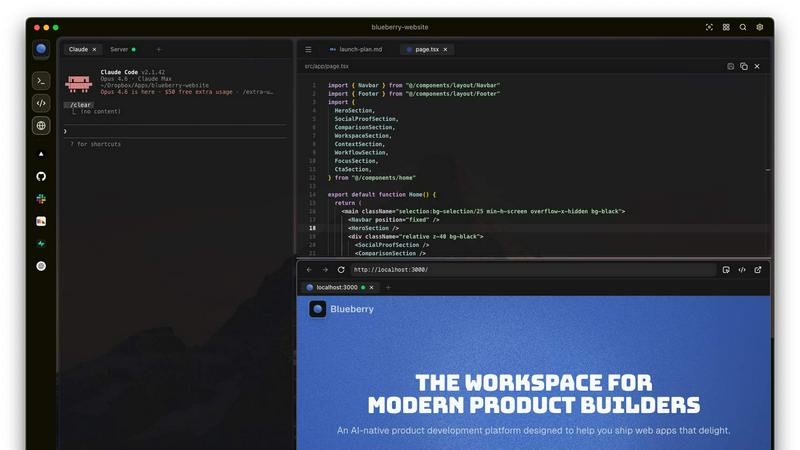
Blueberry is an AI-native Mac workspace that unites your editor, terminal, and browser for seamless product development.
Last updated: February 28, 2026

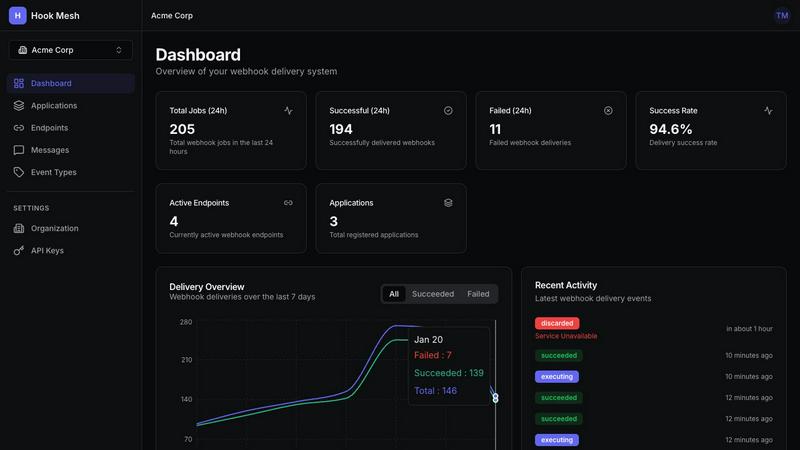
HookMesh delivers reliable webhooks with automatic retries and a self-service portal for your customers.
Last updated: February 28, 2026
Visual Comparison
Blueberry
HookMesh
Feature Comparison
Blueberry
Unified AI-Native Workspace
Blueberry integrates a professional-grade code editor, a fully-featured terminal, and a live preview browser into one cohesive interface. This trinity of tools is designed to work in harmony, sharing state and context seamlessly. You can write code, run commands, and see the changes reflected instantly without ever leaving the application or managing multiple windows, creating a truly immersive development environment.
Full-Context AI via MCP
At the heart of Blueberry is its built-in MCP server, which grants connected AI models a live, comprehensive view of your workspace. The AI can see your current code files, real-time terminal output, the state of your preview browser, and data from pinned apps. This eliminates guesswork and manual context provisioning, allowing for accurate code explanations, debugging, and feature suggestions based on your exact project state.
Pinned Applications & Visual Context
Beyond core dev tools, Blueberry allows you to dock essential web apps like GitHub, Linear, Figma, or PostHog directly within your workspace. These pinned apps load with your project and share context with your AI. Furthermore, you can provide visual context by capturing screenshots or using an element selector directly from the preview browser, bridging the gap between code and visual design.
Multi-Device Live Preview
The integrated preview browser isn't just a simple window. It includes built-in views for desktop, tablet, and mobile screen sizes, allowing you to instantly see how your application will render for users on different devices. This ensures responsive design and user experience can be validated continuously during development without needing external tools or emulators.
HookMesh
Reliable Delivery Engine
HookMesh's core infrastructure guarantees webhooks are never lost. It employs intelligent automatic retries with exponential backoff and jitter, persistently attempting delivery for up to 48 hours. Coupled with circuit breaker patterns that automatically disable failing endpoints to protect system health, and idempotency keys to prevent duplicate processing, it ensures at-least-once delivery without the operational headache.
Embedded Customer Portal
Provide your customers with direct visibility and control through HookMesh's white-labeled, embeddable portal. This self-service interface allows your users to add, verify, and manage their own webhook endpoints without requiring your support team's intervention. It dramatically reduces support overhead while improving the customer experience.
Comprehensive Delivery Visibility
Debugging delivery issues transforms from a hours-long log search into a simple dashboard check. The portal provides complete logs for every webhook attempt, including full HTTP request and response details, headers, and status codes. This end-to-end transparency is invaluable for both your team and your customers when diagnosing integration issues.
Developer-First SDKs & Tools
Ship webhooks in minutes, not months. HookMesh offers official, well-maintained SDKs for popular languages like JavaScript, Python, and Go, allowing you to send events with just a few lines of code. The included Playground lets you test and debug webhook payloads and signatures before going live, streamlining the development workflow.
Use Cases
Blueberry
Rapid Full-Stack Prototyping
Developers building new web applications can use Blueberry to swiftly iterate on both frontend and backend code. Write an API route in the editor, test it via curl in the terminal, and immediately see the frontend fetch and display the data in the live preview—all within a single, fluid workflow. The AI can assist across all these layers with full context.
AI-Powered Debugging & Refactoring
When encountering a bug or planning a refactor, you can leverage the AI's deep workspace awareness. Ask it questions like "why is this component not updating?" or "how can I simplify this state logic?" The AI can analyze the relevant code, review terminal errors, and even inspect the current browser DOM to provide precise, actionable answers.
Collaborative Design-Development Handoff
For teams using tools like Figma, designers can share links pinned within Blueberry. Developers can then reference the designs directly while coding components. Using the screenshot and element select features, they can ask the AI for help implementing specific UI elements, ensuring a faithful translation from design to code.
Context-Rich Onboarding & Exploration
New team members or developers exploring an unfamiliar codebase can use Blueberry to get up to speed quickly. They can ask the AI broad questions about the project structure or specific queries about how a particular feature works, and the AI can guide them through the relevant files, dependencies, and even running application state.
HookMesh
SaaS Platform Notifications
Product-led SaaS companies can offload the delivery of critical event notifications—like new user sign-ups, subscription upgrades, or data export completions—to HookMesh. This ensures their customers' systems are informed reliably, enabling automated workflows without the platform worrying about delivery failures or queue backups.
E-commerce Order Sync
E-commerce platforms can use HookMesh to reliably push order confirmation, shipment status, and fulfillment updates to merchant ERPs or internal systems. The guaranteed delivery and retry logic ensure no order data is lost in transit, which is critical for inventory and accounting synchronization.
Financial Transaction Webhooks
Fintech apps handling payments, invoicing, or wallet transactions require absolute reliability in webhook delivery. HookMesh's robust retry mechanisms and idempotency keys ensure that transaction statuses (e.g., payment.succeeded, transfer.failed) are delivered at least once, preventing missed events that could lead to financial discrepancies.
Internal Event-Driven Architecture
Development teams can use HookMesh as a reliable internal message bus for microservices communication. By sending events to HookMesh, services can ensure other internal systems are notified of state changes with built-in reliability patterns, simplifying the decoupling of services without building complex queuing systems.
Overview
About Blueberry
Blueberry is an AI-native product development platform for macOS, designed to fundamentally change how modern product builders work. It consolidates the essential tools of web development—a code editor, terminal, and live preview browser—into a single, focused workspace. This eliminates the constant, disruptive context-switching between disparate applications, allowing developers and builders to maintain deep focus and flow. Blueberry is built for the new era of AI-assisted development, where the assistant is not just an add-on but a core, integrated member of the team. Its key innovation is providing AI models like Claude, Gemini, or Codex with full, real-time context over your entire project through its built-in MCP (Model Context Protocol) server. This means your AI can see your open files, terminal output, browser state, and even pinned applications like Figma or Linear, enabling it to offer precise, context-aware assistance without the need for manual copy-pasting. The platform is crafted to help you ship web applications that delight, offering a seamless, unified environment from initial code to final preview across all device types. It is currently free during its beta period.
About HookMesh
HookMesh is the definitive infrastructure platform for reliable webhook delivery, purpose-built for modern SaaS products. It eliminates the immense engineering burden and operational risk of building and maintaining webhook systems in-house. For developers and product teams, managing retry logic with exponential backoff, implementing circuit breakers, and debugging failed deliveries are complex, time-consuming tasks that distract from core product development. HookMesh provides a battle-tested, fully managed solution that guarantees at-least-once delivery, ensuring your application events reach customer endpoints consistently and reliably. Beyond robust backend infrastructure, HookMesh uniquely empowers your customers with a self-service portal for managing their webhook endpoints, viewing real-time delivery logs, and replaying failures with one click. This combination of ironclad reliability and superior customer visibility makes HookMesh the essential choice for any business that depends on webhooks to power integrations, notifications, and real-time data sync, offering true peace of mind.
Frequently Asked Questions
Blueberry FAQ
What is MCP and how does Blueberry use it?
MCP stands for Model Context Protocol, a standard for providing AI models with access to tools and data. Blueberry has a built-in MCP server that acts as a bridge, giving AI models like Claude a live, read-only view of your entire workspace—your open files, terminal sessions, browser preview, and pinned apps. This allows the AI to understand your project's full context without manual copying and pasting.
Is Blueberry a full-featured code editor?
Yes. Blueberry includes a professional, real code editor with essential features like full syntax highlighting, multi-cursor support, find and replace, and Git integration. It is designed to be powerful enough for serious development work while being seamlessly integrated with the terminal and browser, forming a complete development environment.
Which AI models does Blueberry support?
Blueberry can connect to any AI model that supports the MCP standard. This includes popular models like Anthropic's Claude, Google's Gemini, and OpenAI's Codex, among others. You configure the connection to your preferred model, and Blueberry provides it with the rich context from your workspace.
Is Blueberry really free?
Yes, Blueberry is completely free during its beta period. The team is focused on refining the product with feedback from early users. There is no indication of future pricing within the provided content, allowing builders to explore and integrate the platform into their workflow at no cost.
HookMesh FAQ
How does HookMesh ensure webhooks are delivered?
HookMesh ensures delivery through a multi-layered approach. Every webhook is queued and sent with automatic retries using exponential backoff and jitter for up to 48 hours. If an endpoint is consistently failing, a circuit breaker temporarily disables it to prevent system-wide issues. All events are sent with idempotency keys, guaranteeing at-least-once delivery and protecting against duplicate processing on the recipient's side.
Can my customers manage their own webhooks?
Yes, this is a core feature of HookMesh. You can provide your customers with an embedded, self-service portal where they can add, update, and verify their own webhook endpoints. They also get full access to delivery logs and can replay any failed webhook with a single click, significantly reducing your support burden.
What happens if a webhook fails all retry attempts?
If a webhook exhausts all retry attempts over the configured period (up to 48 hours), it is marked as permanently failed. However, these failures are clearly logged in the customer portal. A key feature is the "one-click replay" function, which allows you or your customer to manually retry the specific failed delivery on-demand, providing a final recourse for critical events.
Is there a free tier to get started?
Absolutely. HookMesh offers a generous Free plan that includes 5,000 webhook deliveries per month at no cost, with access to all core reliability features and 7-day log retention. This allows you to integrate, test, and evaluate the platform in your staging or production environment without requiring a credit card.
Alternatives
Blueberry Alternatives
Blueberry is a macOS application designed for developers, consolidating the essential tools of an editor, terminal, and browser into a single, unified workspace. This category of integrated development environments (IDEs) or workspace tools aims to streamline workflow by reducing context switching between disparate windows. Users often explore alternatives for several practical reasons. These can include platform restrictions, as Blueberry is currently exclusive to macOS, leaving Windows and Linux users seeking comparable solutions. Others may look for different feature integrations, specific pricing models beyond a free beta, or a more established product with a longer development history. When evaluating alternatives, key considerations should be your primary operating system, the specific tools and AI models you need to integrate, and your preferred workflow. The core value lies in finding a solution that effectively minimizes window management overhead and seamlessly connects your coding, command-line, and preview environments without constant manual context sharing.
HookMesh Alternatives
HookMesh is a specialized platform for reliable webhook delivery, designed for SaaS development teams. It provides a managed service to handle the complexities of sending webhooks, including automatic retries, customer portals, and detailed logging. Users often explore alternatives for various reasons. These can include budget constraints, the need for a different feature set, or a preference for a platform that integrates more tightly with their existing infrastructure stack. Some may also seek a solution with a different operational model. When evaluating alternatives, key considerations should be reliability guarantees, developer experience, and the level of visibility provided to end-users. A robust solution should offer at-least-once delivery, clear debugging tools, and a way to empower customers to manage their own endpoints without requiring constant support.