
Kane AI vs Project20x
Side-by-side comparison to help you choose the right AI tool.

Kane AI
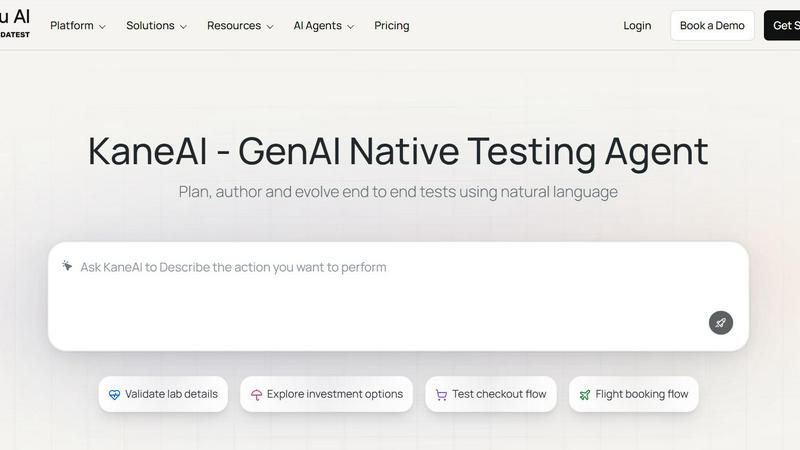
Kane AI empowers teams to effortlessly plan, create, and evolve tests using natural language for seamless quality.
Last updated: February 28, 2026

Project20x
Project20x provides AI governance to ensure your policies are compliant and effective.
Last updated: March 4, 2026
Visual Comparison
Kane AI
Project20x

Feature Comparison
Kane AI
Intelligent Test Generation
KaneAI utilizes NLP-based instructions to facilitate intelligent test generation. Teams can converse with KaneAI to effortlessly automate tests, transforming high-level goals into actionable test steps without the need for extensive coding knowledge.
Unified Testing Framework
This all-in-one framework allows for end-to-end testing across various layers, including databases, APIs, and accessibility checks. KaneAI ensures comprehensive coverage by integrating multiple testing aspects into a single workflow, eliminating silos and gaps.
Seamless Integration with Workflows
KaneAI integrates smoothly with tools like JIRA and Azure DevOps, enabling teams to create and manage test cases directly within their existing workflows. This integration allows for real-time updates and streamlined communication between development and QA teams.
Dynamic Test Data Generation
The platform automatically generates test data during the authoring process, ensuring that tests are always relevant and reflective of real-world scenarios. This feature enhances the accuracy and reliability of test executions, reducing manual setup efforts.
Project20x
Governance Layer: AI-Powered Policy Crafting
This foundational layer employs a sophisticated ten-step AI methodology to assist lawmakers in the policy development process. It analyzes draft legislative texts for clarity, consistency, and potential conflicts with existing regulations. By providing data-driven insights and highlighting ambiguities, it empowers officials to create more sound, coherent, and implementable policies from the outset, reducing future administrative burdens and legal challenges.
Management Layer: Rules as Code Automation
Once a policy is approved, the Management Layer transforms it from natural language into functional, machine-executable code. This "Rules as Code" approach automates complex regulatory logic into clear workflows and decision trees. It enables government agencies to deploy consistent, accurate, and efficient digital services rapidly, ensuring that the enacted law is directly mirrored in its operational implementation without manual interpretation gaps.
Interface Layer: Citizen-Facing AI Agents
The Interface Layer provides the public face of governance, offering citizens 24/7 access to AI agents trained exclusively on the codified policies from the Management Layer. These agents can guide users through processes, answer complex eligibility questions, and help complete forms or applications. This delivers a consistent, instant, and user-friendly service experience, dramatically streamlining public interactions and reducing wait times.
Full-Stack Transparency & Audit Trail
Project20x is built with a commitment to traceability and accountability at every level. Every policy change, code translation, and citizen interaction can be logged, monitored, and audited. This creates a verifiable chain of custody from legislative intent to public service delivery, enabling rigorous human oversight, performance quantification, and ensuring that all automated processes remain transparent and accountable to both officials and the public.
Use Cases
Kane AI
Automated Test Case Creation
Teams can input various document types, including JIRA tickets and PDFs, to automatically generate structured test cases. This capability saves valuable time and ensures that test cases are aligned with project specifications.
Continuous Testing in Agile Environments
KaneAI supports continuous testing by enabling teams to trigger test automation directly from conversations in platforms like JIRA. This feature is particularly beneficial for agile teams that require rapid feedback and iteration.
Comprehensive API Testing
By validating APIs alongside UI flows, KaneAI provides a holistic approach to testing that reduces the risk of gaps in coverage. This feature ensures that both frontend and backend components work seamlessly together.
Real-Time Network Monitoring
KaneAI performs real-time network checks to validate responses, statuses, and payloads, ensuring that application flows are reliable. This capability helps teams identify and resolve issues before they impact end-users.
Project20x
Streamlining Federal Grant Applications
Agencies like USAID or the USDA can use Project20x to codify intricate grant eligibility rules and application procedures. Citizens and organizations can then interact with an AI agent that accurately assesses their qualification in real-time, guides them through the required documentation, and automates parts of the initial review process, significantly reducing processing times and improving applicant success rates.
Modernizing Business Regulation Compliance
The Department of Commerce (DOC) can implement the platform to translate business regulations, licensing requirements, and reporting mandates into clear digital workflows. Small businesses can use the citizen interface to navigate compliance steps, understand obligations based on their specific profile, and submit required information through automated forms, lowering the barrier to regulatory adherence.
Automating Veteran Benefit Claims
The Department of Veterans Affairs could deploy Project20x to manage the complex web of benefit eligibility rules. The AI-driven interface would help veterans understand which benefits they qualify for, assist in compiling necessary service records and medical evidence, and submit a structured, pre-validated claim to caseworkers, accelerating support delivery and reducing claimant frustration.
Legislative Drafting and Analysis for Lawmakers
Legislative bodies can utilize the Governance Layer as a collaborative tool for drafting new bills or amending existing statutes. The AI analyzes text for unintended consequences, conflicts with other laws, and clarity of language. This provides lawmakers with critical, objective insights to craft more effective and precisely worded legislation before it reaches the floor for a vote.
Overview
About Kane AI
KaneAI by TestMu AI is a revolutionary GenAI-native testing agent designed to empower high-speed Quality Engineering teams. This innovative tool simplifies the testing process by enabling test authoring, management, debugging, and evolution using natural language. With KaneAI, teams can drastically reduce the time and expertise required to initiate and scale test automation, making it an ideal solution for organizations looking to enhance their testing capabilities. Unlike traditional low-code tools, KaneAI adeptly manages complex workflows across all major programming languages and frameworks without sacrificing performance. Its ability to generate intelligent tests through natural language processing (NLP) streamlines the testing lifecycle, ensuring that teams can maintain alignment with business objectives while achieving high-quality software delivery. By providing seamless integrations, support for API testing, and automated bug detection, KaneAI stands out as a comprehensive solution for teams aiming to optimize their testing processes and deliver reliable software efficiently.
About Project20x
Project20x is an AI-native platform engineered to fundamentally transform the relationship between government, policy, and the public. It addresses the core inefficiency of modern governance: the gap between complex, static regulatory frameworks and the dynamic, accessible digital services citizens expect. The platform serves a tripartite audience: lawmakers and agencies seeking to draft and implement clearer, more effective policies; government managers responsible for operationalizing these policies into efficient services; and citizens who need straightforward, 24/7 access to public support. Its core value proposition lies in its unique three-layer architecture, which seamlessly translates legislative intent into automated, transparent, and user-friendly digital processes. By applying a rigorous "Rules as Code" methodology, Project20x ensures that policies are not just documents but executable, auditable code. This creates a new standard for governmental operations where every action is traceable, quantifiable, and designed with both human oversight and AI efficiency at its heart, fostering unprecedented levels of transparency, accountability, and public engagement.
Frequently Asked Questions
Kane AI FAQ
What types of programming languages and frameworks does Kane AI support?
KaneAI is designed to handle complex workflows across all major programming languages and frameworks, ensuring flexibility and adaptability for diverse development environments.
How does Kane AI ensure the accuracy of its test cases?
KaneAI employs NLP to convert high-level objectives into structured test cases, allowing for a high degree of accuracy while reducing the manual effort required to create tests.
Can Kane AI integrate with my existing tools?
Yes, KaneAI integrates seamlessly with popular tools like JIRA and Azure DevOps, allowing for a streamlined workflow that enhances collaboration between QA and development teams.
Is Kane AI suitable for both web and mobile testing?
Absolutely. KaneAI supports test authoring and execution across both web and mobile platforms, making it a versatile solution for teams working on diverse applications.
Project20x FAQ
How does Project20x ensure the AI does not make incorrect or biased decisions?
Project20x is designed as a decision-support and automation tool, not an autonomous decision-maker. The AI agents in the Interface Layer are strictly trained on the codified rules from the Management Layer, which are themselves a direct translation of human-written policy. All complex or final decisions remain subject to human review and oversight. The platform's full audit trail ensures any outcome can be traced back to the originating rule and data inputs for validation.
What is "Rules as Code" and why is it important?
"Rules as Code" is the methodology of writing legal and regulatory rules in a precise, machine-readable format alongside their traditional natural language form. This is crucial because it eliminates ambiguity. When a law is translated into code, it can be executed consistently by software, ensuring every citizen interacts with the exact same interpretation of the rule. It turns static policy into dynamic, actionable digital services.
Is citizen data secure on the Project20x platform?
Security is a foundational principle for Project20x. The platform is built with enterprise-grade security protocols to protect sensitive citizen and governmental data. Access controls, encryption, and comprehensive audit logs are standard. Furthermore, by centralizing and codifying processes, the platform can often reduce data handling points and increase the consistency of security measures applied across different services.
Can Project20x integrate with existing government IT systems?
Yes, a core design consideration for Project20x is interoperability. The platform is built to function as an enabling layer on top of or alongside existing legacy systems. Through secure APIs and modular design, the Management Layer can feed automated decisions and structured data into current case management, CRM, or database systems, allowing agencies to modernize service delivery without a complete and costly infrastructure overhaul.
Alternatives
Kane AI Alternatives
Kane AI is a pioneering GenAI-native testing agent that empowers quality engineering teams to efficiently plan, create, and evolve tests through natural language. Designed to streamline the test automation process, Kane AI significantly reduces the time and expertise needed for effective test management, making it an attractive solution for organizations aiming for rapid software delivery. Users often seek alternatives to Kane AI due to a variety of reasons, including pricing concerns, specific feature requirements, or compatibility with different platforms and workflows. When searching for a suitable alternative, it's essential to consider factors such as the tool's ability to integrate with existing systems, the range of programming languages and frameworks supported, and the overall user experience. A thorough evaluation of these aspects can help ensure a seamless transition and continued success in quality engineering efforts.
Project20x Alternatives
Project20x is an AI governance platform designed to help government entities translate complex policies into clear, actionable digital workflows. It falls within the category of specialized AI assistants focused on public sector compliance and operational efficiency. Users may explore alternatives for various reasons, such as differing budgetary constraints, the need for a platform tailored to a specific regulatory domain, or a preference for a different deployment model. The search often stems from a need to find the precise balance of automation, customization, and integration capabilities for their unique environment. When evaluating other solutions, key considerations should include the depth of policy analysis and "Rules as Code" functionality, the robustness of security and audit trails, and the quality of the citizen-facing interface. The ideal alternative will demonstrate a clear methodology for maintaining human oversight while leveraging automation to enhance both policy creation and public service delivery.