
HookMesh vs qtrl.ai
Side-by-side comparison to help you choose the right AI tool.

HookMesh delivers reliable webhooks with automatic retries and a self-service portal for your customers.
Last updated: February 28, 2026

qtrl.ai
qtrl.ai scales QA testing with AI agents while ensuring full team control and governance.
Last updated: March 4, 2026
Visual Comparison
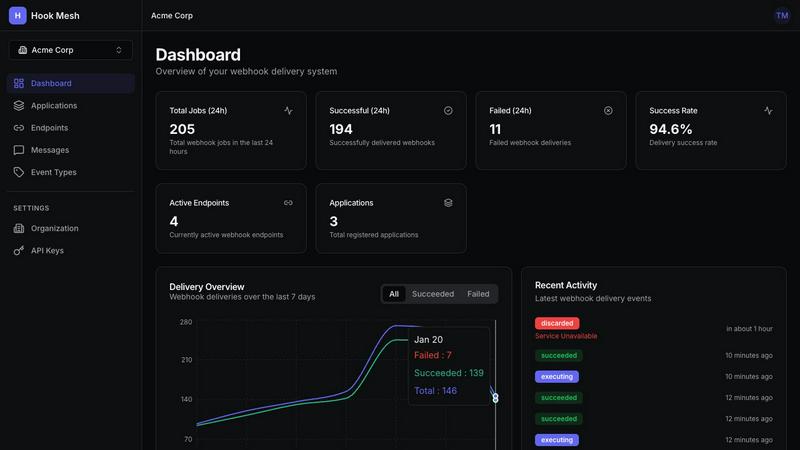
HookMesh
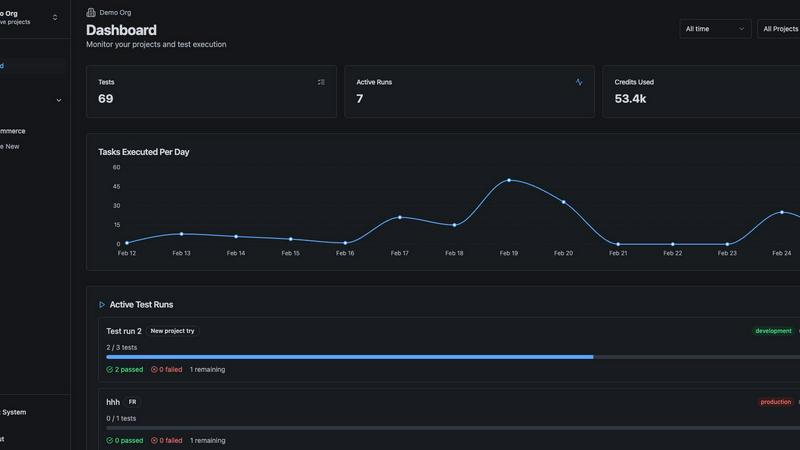
qtrl.ai
Feature Comparison
HookMesh
Reliable Delivery Engine
HookMesh's core infrastructure guarantees webhooks are never lost. It employs intelligent automatic retries with exponential backoff and jitter, persistently attempting delivery for up to 48 hours. Coupled with circuit breaker patterns that automatically disable failing endpoints to protect system health, and idempotency keys to prevent duplicate processing, it ensures at-least-once delivery without the operational headache.
Embedded Customer Portal
Provide your customers with direct visibility and control through HookMesh's white-labeled, embeddable portal. This self-service interface allows your users to add, verify, and manage their own webhook endpoints without requiring your support team's intervention. It dramatically reduces support overhead while improving the customer experience.
Comprehensive Delivery Visibility
Debugging delivery issues transforms from a hours-long log search into a simple dashboard check. The portal provides complete logs for every webhook attempt, including full HTTP request and response details, headers, and status codes. This end-to-end transparency is invaluable for both your team and your customers when diagnosing integration issues.
Developer-First SDKs & Tools
Ship webhooks in minutes, not months. HookMesh offers official, well-maintained SDKs for popular languages like JavaScript, Python, and Go, allowing you to send events with just a few lines of code. The included Playground lets you test and debug webhook payloads and signatures before going live, streamlining the development workflow.
qtrl.ai
Enterprise-Grade Test Management
qtrl provides a centralized, structured foundation for all QA activities. Teams can create, organize, and manage test cases, plans, and runs in one place. This core system ensures full traceability from requirements to test coverage and offers comprehensive audit trails, making it built for compliance and giving engineering leads clear visibility into quality status and potential risks.
Progressive AI Automation
Instead of a risky "black-box" AI-first approach, qtrl introduces intelligent automation progressively. Teams begin with human-written test instructions. When ready, they can leverage AI to generate tests from plain English descriptions. All AI-suggested tests are fully reviewable and approvable, allowing you to increase autonomy at your own pace without ever losing oversight or control.
Autonomous QA Agents
These powerful agents execute test instructions on demand or continuously across multiple browsers and environments. They operate within your defined rules and permissions, performing real browser execution—not simulations. This allows for scalable, reliable test execution that integrates seamlessly into existing development and deployment workflows.
Adaptive Memory & Governance
qtrl builds a living knowledge base of your application by learning from exploration, test execution, and issues. This adaptive memory powers smarter, context-aware test generation that improves over time. Crucially, this intelligence is coupled with governance-by-design: full agent visibility, permissioned autonomy levels, and enterprise-ready security ensure AI earns trust through transparency.
Use Cases
HookMesh
SaaS Platform Notifications
Product-led SaaS companies can offload the delivery of critical event notifications—like new user sign-ups, subscription upgrades, or data export completions—to HookMesh. This ensures their customers' systems are informed reliably, enabling automated workflows without the platform worrying about delivery failures or queue backups.
E-commerce Order Sync
E-commerce platforms can use HookMesh to reliably push order confirmation, shipment status, and fulfillment updates to merchant ERPs or internal systems. The guaranteed delivery and retry logic ensure no order data is lost in transit, which is critical for inventory and accounting synchronization.
Financial Transaction Webhooks
Fintech apps handling payments, invoicing, or wallet transactions require absolute reliability in webhook delivery. HookMesh's robust retry mechanisms and idempotency keys ensure that transaction statuses (e.g., payment.succeeded, transfer.failed) are delivered at least once, preventing missed events that could lead to financial discrepancies.
Internal Event-Driven Architecture
Development teams can use HookMesh as a reliable internal message bus for microservices communication. By sending events to HookMesh, services can ensure other internal systems are notified of state changes with built-in reliability patterns, simplifying the decoupling of services without building complex queuing systems.
qtrl.ai
Scaling Beyond Manual Testing
For QA teams overwhelmed by repetitive manual test cycles, qtrl provides a structured path forward. Start by organizing manual test cases in the platform, then progressively automate the most tedious flows using AI-generated tests. This allows teams to scale their coverage and frequency of testing without linearly increasing headcount or burnout.
Modernizing Legacy QA Workflows
Companies relying on outdated, siloed, or script-heavy automation frameworks can consolidate and modernize with qtrl. The platform brings test management, automation, and execution into a single, governed environment, replacing brittle scripts with maintainable, AI-assisted tests and providing the audit trails legacy enterprises require.
Governing AI-Powered QA
For organizations intrigued by AI automation but concerned about loss of control and auditability, qtrl offers the perfect solution. Its permissioned autonomy levels, full review cycles, and detailed execution logs ensure that AI agents operate as a transparent, accountable extension of the team, making advanced automation safe for regulated industries.
Enhancing Product-Led Engineering
Product-led engineering teams that prioritize speed and user experience need quality feedback that keeps pace. qtrl integrates with CI/CD pipelines and provides continuous quality feedback. Autonomous agents can run tests across development, staging, and production environments, ensuring rapid releases don't compromise on product stability.
Overview
About HookMesh
HookMesh is the definitive infrastructure platform for reliable webhook delivery, purpose-built for modern SaaS products. It eliminates the immense engineering burden and operational risk of building and maintaining webhook systems in-house. For developers and product teams, managing retry logic with exponential backoff, implementing circuit breakers, and debugging failed deliveries are complex, time-consuming tasks that distract from core product development. HookMesh provides a battle-tested, fully managed solution that guarantees at-least-once delivery, ensuring your application events reach customer endpoints consistently and reliably. Beyond robust backend infrastructure, HookMesh uniquely empowers your customers with a self-service portal for managing their webhook endpoints, viewing real-time delivery logs, and replaying failures with one click. This combination of ironclad reliability and superior customer visibility makes HookMesh the essential choice for any business that depends on webhooks to power integrations, notifications, and real-time data sync, offering true peace of mind.
About qtrl.ai
qtrl.ai is a modern QA platform engineered for software teams who need to scale their quality assurance efforts without compromising on control, governance, or trust. It addresses the fundamental tension in software testing: the slow, unscalable nature of manual processes versus the brittle, expensive complexity of traditional test automation. qtrl provides a unified solution by combining robust, enterprise-grade test management with a progressive, trustworthy layer of AI-powered automation. This creates a centralized hub where teams can meticulously organize test cases, plan and execute test runs, trace requirements to coverage, and monitor quality through real-time dashboards. The platform is designed for progression, allowing teams to start with structured manual test management and gradually introduce intelligent autonomous agents. These agents can generate and maintain UI tests from plain English, execute them at scale across real browsers and environments, and adapt as the application evolves. Built for product-led engineering teams, QA groups moving beyond manual testing, and enterprises with strict compliance needs, qtrl.ai offers a trusted, transparent path to faster, more intelligent, and fully governed quality assurance.
Frequently Asked Questions
HookMesh FAQ
How does HookMesh ensure webhooks are delivered?
HookMesh ensures delivery through a multi-layered approach. Every webhook is queued and sent with automatic retries using exponential backoff and jitter for up to 48 hours. If an endpoint is consistently failing, a circuit breaker temporarily disables it to prevent system-wide issues. All events are sent with idempotency keys, guaranteeing at-least-once delivery and protecting against duplicate processing on the recipient's side.
Can my customers manage their own webhooks?
Yes, this is a core feature of HookMesh. You can provide your customers with an embedded, self-service portal where they can add, update, and verify their own webhook endpoints. They also get full access to delivery logs and can replay any failed webhook with a single click, significantly reducing your support burden.
What happens if a webhook fails all retry attempts?
If a webhook exhausts all retry attempts over the configured period (up to 48 hours), it is marked as permanently failed. However, these failures are clearly logged in the customer portal. A key feature is the "one-click replay" function, which allows you or your customer to manually retry the specific failed delivery on-demand, providing a final recourse for critical events.
Is there a free tier to get started?
Absolutely. HookMesh offers a generous Free plan that includes 5,000 webhook deliveries per month at no cost, with access to all core reliability features and 7-day log retention. This allows you to integrate, test, and evaluate the platform in your staging or production environment without requiring a credit card.
qtrl.ai FAQ
How does qtrl.ai ensure tests remain reliable as my application changes?
qtrl's Adaptive Memory continuously learns from your application's behavior during test execution and exploration. When UI elements or workflows change, the AI can often suggest updates to existing tests to keep them functional. Furthermore, all AI-suggested changes are presented for human review and approval, ensuring you maintain control over test maintenance.
Is qtrl.ai suitable for teams with strict security and compliance requirements?
Absolutely. qtrl is built with enterprise-grade security and governance from the ground up. Features include full audit trails, permissioned access controls, encrypted secrets management (where secrets are never exposed to the AI), and compliance-ready reporting. It is designed for teams in regulated industries that cannot compromise on oversight.
Can I use qtrl.ai alongside my existing tools like Jira or CI/CD systems?
Yes, qtrl is built for real workflows and integrates with the tools you already use. It supports requirements management integration, connects with CI/CD pipelines for automated test execution, and is designed to fit into your existing development ecosystem, providing quality feedback loops without forcing a complete toolchain overhaul.
What makes qtrl's AI different from other "autonomous" testing tools?
qtrl rejects the "black-box" AI-first model. Its AI is progressive and permissioned. You start with control and grant autonomy incrementally as the tool proves its value. Every AI-generated test or change is reviewable, and agents operate within strict rules you set. This focus on earned trust and transparency distinguishes it from unpredictable, fully autonomous solutions.
Alternatives
HookMesh Alternatives
HookMesh is a specialized platform for reliable webhook delivery, designed for SaaS development teams. It provides a managed service to handle the complexities of sending webhooks, including automatic retries, customer portals, and detailed logging. Users often explore alternatives for various reasons. These can include budget constraints, the need for a different feature set, or a preference for a platform that integrates more tightly with their existing infrastructure stack. Some may also seek a solution with a different operational model. When evaluating alternatives, key considerations should be reliability guarantees, developer experience, and the level of visibility provided to end-users. A robust solution should offer at-least-once delivery, clear debugging tools, and a way to empower customers to manage their own endpoints without requiring constant support.
qtrl.ai Alternatives
qtrl.ai is a modern QA platform in the automation and dev tools category. It uniquely combines enterprise-grade test management with a progressive AI layer, allowing teams to scale intelligent testing while maintaining full control and governance. Users often explore alternatives for various reasons, such as budget constraints, specific feature requirements, or the need to integrate with a particular tech stack. The search for a different solution is a normal part of finding the right fit for a team's unique workflow and maturity level. When evaluating options, consider the balance between structured test management and intelligent automation. Look for a platform that offers clear visibility into quality metrics, supports a gradual adoption of AI, and provides the security and audit trails necessary for enterprise environments.