
HookMesh vs Hostim.dev
Side-by-side comparison to help you choose the right AI tool.

HookMesh delivers reliable webhooks with automatic retries and a self-service portal for your customers.
Last updated: February 28, 2026

Hostim.dev
Hostim.dev simplifies app deployment with Docker and built-in databases, offering fast, secure hosting on EU bare-metal.
Last updated: March 1, 2026
Visual Comparison
HookMesh
Hostim.dev
Feature Comparison
HookMesh
Reliable Delivery Engine
HookMesh's core infrastructure guarantees webhooks are never lost. It employs intelligent automatic retries with exponential backoff and jitter, persistently attempting delivery for up to 48 hours. Coupled with circuit breaker patterns that automatically disable failing endpoints to protect system health, and idempotency keys to prevent duplicate processing, it ensures at-least-once delivery without the operational headache.
Embedded Customer Portal
Provide your customers with direct visibility and control through HookMesh's white-labeled, embeddable portal. This self-service interface allows your users to add, verify, and manage their own webhook endpoints without requiring your support team's intervention. It dramatically reduces support overhead while improving the customer experience.
Comprehensive Delivery Visibility
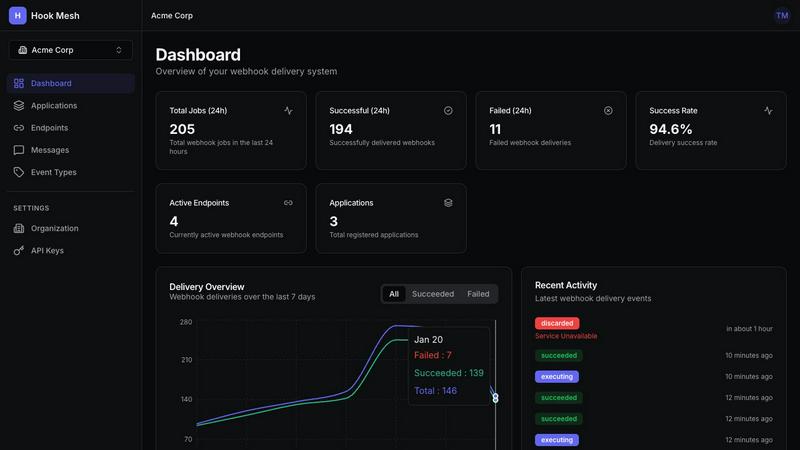
Debugging delivery issues transforms from a hours-long log search into a simple dashboard check. The portal provides complete logs for every webhook attempt, including full HTTP request and response details, headers, and status codes. This end-to-end transparency is invaluable for both your team and your customers when diagnosing integration issues.
Developer-First SDKs & Tools
Ship webhooks in minutes, not months. HookMesh offers official, well-maintained SDKs for popular languages like JavaScript, Python, and Go, allowing you to send events with just a few lines of code. The included Playground lets you test and debug webhook payloads and signatures before going live, streamlining the development workflow.
Hostim.dev
Easy Deployment Options
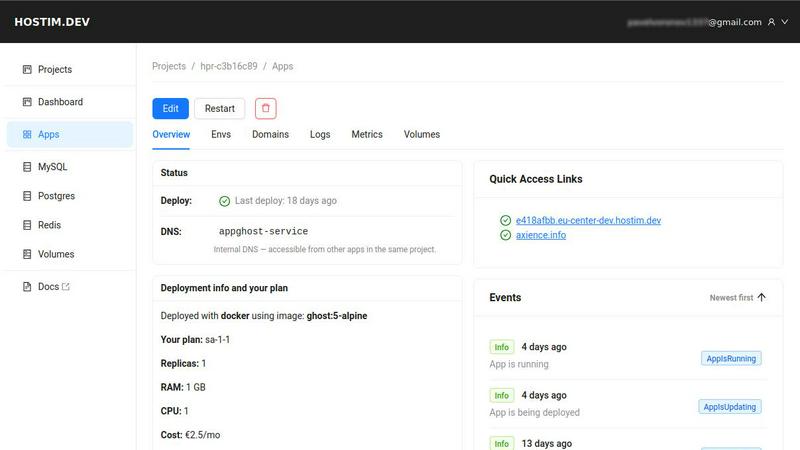
Hostim.dev allows developers to deploy their applications with ease, supporting Docker images, Git repositories, and Docker Compose files. This flexibility means developers can choose their preferred method of deployment without complex configurations or extensive setup.
Built-in Managed Databases
The platform offers built-in managed databases such as MySQL and PostgreSQL, which are provisioned instantly. This feature removes the hassle of setting up separate database services, ensuring that developers can focus on application development rather than infrastructure management.
Secure and Isolated Environments
Each project on Hostim.dev runs within its own isolated Kubernetes namespace, providing a secure environment for applications. Automatic HTTPS ensures secure connections, while live logs and metrics facilitate monitoring and troubleshooting without compromising security.
Transparent Pricing Model
Hostim.dev adopts a straightforward pricing model starting at €2.50 per month, with no hidden fees. This transparency allows developers and agencies to budget effectively and provide clear cost breakdowns to clients, making it easier to manage project finances.
Use Cases
HookMesh
SaaS Platform Notifications
Product-led SaaS companies can offload the delivery of critical event notifications—like new user sign-ups, subscription upgrades, or data export completions—to HookMesh. This ensures their customers' systems are informed reliably, enabling automated workflows without the platform worrying about delivery failures or queue backups.
E-commerce Order Sync
E-commerce platforms can use HookMesh to reliably push order confirmation, shipment status, and fulfillment updates to merchant ERPs or internal systems. The guaranteed delivery and retry logic ensure no order data is lost in transit, which is critical for inventory and accounting synchronization.
Financial Transaction Webhooks
Fintech apps handling payments, invoicing, or wallet transactions require absolute reliability in webhook delivery. HookMesh's robust retry mechanisms and idempotency keys ensure that transaction statuses (e.g., payment.succeeded, transfer.failed) are delivered at least once, preventing missed events that could lead to financial discrepancies.
Internal Event-Driven Architecture
Development teams can use HookMesh as a reliable internal message bus for microservices communication. By sending events to HookMesh, services can ensure other internal systems are notified of state changes with built-in reliability patterns, simplifying the decoupling of services without building complex queuing systems.
Hostim.dev
Freelancers
Freelancers can utilize Hostim.dev to quickly deploy applications for their clients without needing extensive DevOps knowledge. The platform's per-project billing enables clean handovers, making it simple to transition projects to clients.
Agencies
Agencies benefit from the ability to isolate projects for different clients while maintaining control over costs. Hostim.dev's clear cost breakdown per project allows agencies to deliver accurate estimates and manage client budgets effectively.
Students
Hostim.dev serves as an excellent learning platform for students looking to gain hands-on experience with real infrastructure. With a free trial and student credits, they can deploy Docker applications, gain practical knowledge, and build impressive portfolios.
Development Teams
Development teams can leverage Hostim.dev to streamline their CI/CD pipelines by deploying directly from Git repositories. The platform's pre-wired environment variables and built-in monitoring tools enhance collaboration and efficiency among team members.
Overview
About HookMesh
HookMesh is the definitive infrastructure platform for reliable webhook delivery, purpose-built for modern SaaS products. It eliminates the immense engineering burden and operational risk of building and maintaining webhook systems in-house. For developers and product teams, managing retry logic with exponential backoff, implementing circuit breakers, and debugging failed deliveries are complex, time-consuming tasks that distract from core product development. HookMesh provides a battle-tested, fully managed solution that guarantees at-least-once delivery, ensuring your application events reach customer endpoints consistently and reliably. Beyond robust backend infrastructure, HookMesh uniquely empowers your customers with a self-service portal for managing their webhook endpoints, viewing real-time delivery logs, and replaying failures with one click. This combination of ironclad reliability and superior customer visibility makes HookMesh the essential choice for any business that depends on webhooks to power integrations, notifications, and real-time data sync, offering true peace of mind.
About Hostim.dev
Hostim.dev is a state-of-the-art bare-metal Platform-as-a-Service (PaaS) meticulously crafted for developers who prioritize speed and efficiency in launching containerized applications. It eliminates the cumbersome DevOps overhead traditionally associated with application deployment, allowing developers to focus on what truly matters: building and scaling their applications. With seamless deployment options from Docker images, Git repositories, or even complete Docker Compose files, Hostim.dev enables projects to go live within minutes. It manages all essential provisioning and connections, including popular databases like MySQL and PostgreSQL, while ensuring secure HTTPS access and internal networking. Each project operates in its own isolated Kubernetes namespace, promoting security and organization. Hostim.dev also features transparent hourly billing and is GDPR-compliant, with hosting based in Germany. This unique combination of simplicity, control, and a reliable operational environment makes Hostim.dev the ideal solution for developers seeking to streamline their workflows and maximize productivity.
Frequently Asked Questions
HookMesh FAQ
How does HookMesh ensure webhooks are delivered?
HookMesh ensures delivery through a multi-layered approach. Every webhook is queued and sent with automatic retries using exponential backoff and jitter for up to 48 hours. If an endpoint is consistently failing, a circuit breaker temporarily disables it to prevent system-wide issues. All events are sent with idempotency keys, guaranteeing at-least-once delivery and protecting against duplicate processing on the recipient's side.
Can my customers manage their own webhooks?
Yes, this is a core feature of HookMesh. You can provide your customers with an embedded, self-service portal where they can add, update, and verify their own webhook endpoints. They also get full access to delivery logs and can replay any failed webhook with a single click, significantly reducing your support burden.
What happens if a webhook fails all retry attempts?
If a webhook exhausts all retry attempts over the configured period (up to 48 hours), it is marked as permanently failed. However, these failures are clearly logged in the customer portal. A key feature is the "one-click replay" function, which allows you or your customer to manually retry the specific failed delivery on-demand, providing a final recourse for critical events.
Is there a free tier to get started?
Absolutely. HookMesh offers a generous Free plan that includes 5,000 webhook deliveries per month at no cost, with access to all core reliability features and 7-day log retention. This allows you to integrate, test, and evaluate the platform in your staging or production environment without requiring a credit card.
Hostim.dev FAQ
What does the free tier include?
The free tier of Hostim.dev allows users to explore the platform with a 5-day trial, enabling them to deploy applications without any signup required. This is a great way to test the service before committing.
Can I deploy with just a Compose file?
Yes, Hostim.dev enables users to deploy applications using just a Docker Compose file. This feature simplifies the deployment process significantly, allowing developers to go live quickly with minimal configuration.
Where is my app hosted?
Hostim.dev hosts applications on bare-metal servers located in Germany, ensuring compliance with GDPR regulations. This makes it a suitable choice for developers who prioritize data protection and privacy.
Do I need to know Kubernetes?
No, Hostim.dev abstracts the complexities of Kubernetes management. Developers can deploy their applications without needing extensive knowledge of Kubernetes, making it accessible for users at all skill levels.
Alternatives
HookMesh Alternatives
HookMesh is a specialized platform for reliable webhook delivery, designed for SaaS development teams. It provides a managed service to handle the complexities of sending webhooks, including automatic retries, customer portals, and detailed logging. Users often explore alternatives for various reasons. These can include budget constraints, the need for a different feature set, or a preference for a platform that integrates more tightly with their existing infrastructure stack. Some may also seek a solution with a different operational model. When evaluating alternatives, key considerations should be reliability guarantees, developer experience, and the level of visibility provided to end-users. A robust solution should offer at-least-once delivery, clear debugging tools, and a way to empower customers to manage their own endpoints without requiring constant support.
Hostim.dev Alternatives
Hostim.dev is an innovative bare-metal Platform-as-a-Service (PaaS) tailored for developers who want to deploy containerized applications quickly and effectively. By providing an environment that minimizes DevOps complexities, it empowers users to launch their apps using Docker, Git, or Docker Compose seamlessly. The platform ensures that essential services like databases and secure access are readily available, making it an attractive option for many developers. However, users may seek alternatives due to various reasons, including pricing structures, feature sets, or specific platform requirements that better suit their projects. When considering alternatives, it's vital to evaluate factors such as ease of deployment, available integrations, scalability options, and compliance with data regulations to ensure that the chosen platform aligns well with your development needs.