
CloneUI vs Hunyuan3D
Side-by-side comparison to help you choose the right AI tool.

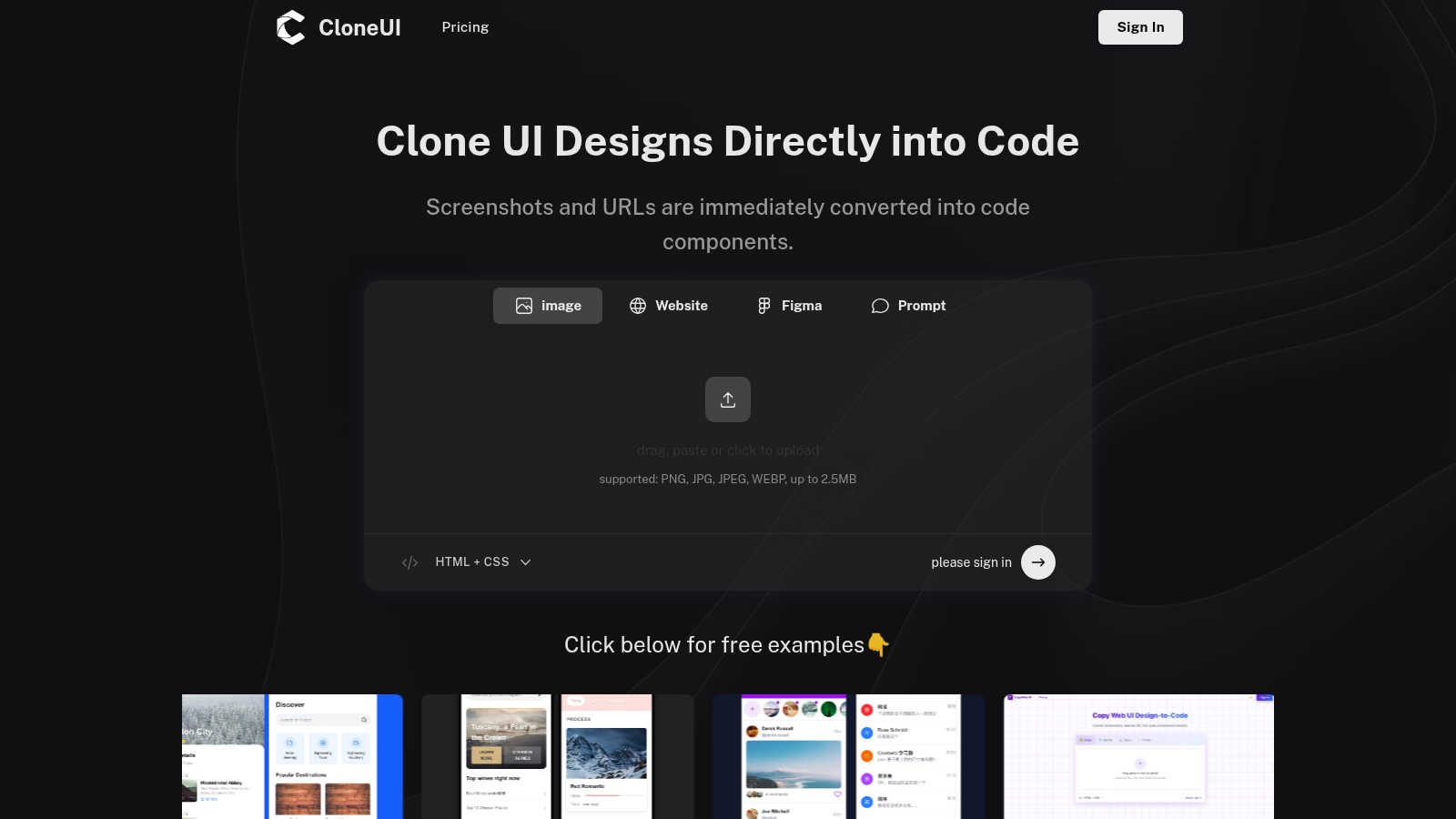
CloneUI instantly converts website screenshots and URLs into clean, responsive React, HTML, or Vue code.
Last updated: March 1, 2026

Hunyuan3D
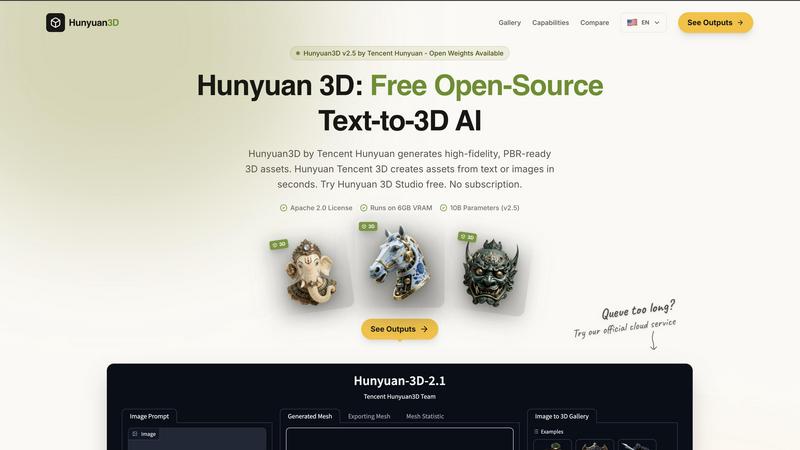
Hunyuan3D quickly transforms text and images into stunning, production-ready 3D assets, all for free and open-source.
Last updated: February 27, 2026
Visual Comparison
CloneUI
Hunyuan3D
Feature Comparison
CloneUI
Multi-Format Design Input
CloneUI accepts a versatile range of inputs to kickstart the code generation process. You can directly upload a screenshot (PNG, JPG, JPEG, WEBP), paste a live website URL for instant cloning, or integrate with Figma designs. This flexibility ensures that whether your inspiration is a sketch, a competitor's site, or a polished design file, CloneUI can begin the conversion immediately, removing friction from the initial step.
Intelligent Component Recognition
At the heart of CloneUI is its advanced AI that performs intelligent component recognition. It doesn't just see pixels; it identifies and maps UI elements like buttons, navigation bars, cards, and forms. This understanding allows the tool to generate semantically meaningful and structurally clean code, replicating the design's hierarchy and interactivity with a high degree of accuracy, far beyond a simple static copy.
Framework-Specific Code Export
CloneUI empowers developers by offering one-click exports to their preferred front-end frameworks. You can receive your generated code tailored for React, Vue, or as standard, plain HTML and CSS. This feature ensures the output seamlessly integrates into your existing project stack, saving additional hours that would otherwise be spent manually refactoring code to fit a specific framework's syntax and patterns.
Built-In Responsiveness
Every line of code generated by CloneUI is crafted to be inherently responsive. The tool ensures that the cloned interfaces adapt fluidly and seamlessly to any screen size, from desktop monitors to mobile phones. This built-in responsiveness guarantees that the visual fidelity and user experience are maintained across devices, providing a mobile-friendly foundation without requiring manual media query adjustments.
Hunyuan3D
Rapid 3D Asset Generation
Hunyuan3D can generate 3D meshes from both text descriptions and single 2D images, significantly reducing the time and effort required for asset creation. This rapid generation capability allows creators to iterate quickly and experiment with different designs without the traditional long hours usually associated with 3D modeling.
High-Quality PBR Textures
The system produces PBR-ready textures at resolutions of up to 4K, ensuring that the generated assets maintain high visual fidelity. These textures are essential for achieving realistic lighting and material effects in various rendering engines, making them suitable for professional applications in games and films.
Clean Mesh Topology
Hunyuan3D guarantees clean mesh topology that is suitable for animation and production pipelines. This feature is crucial for artists and animators who require rigs and deformations to work seamlessly, thereby enhancing the usability of the generated assets in various projects.
Cross-Compatible Integration
The platform is designed to be compatible with popular 3D software such as Blender, Unity, and Unreal Engine. This cross-compatibility means that users can easily integrate their generated assets into their preferred workflows, streamlining the development process and enhancing productivity.
Use Cases
CloneUI
Rapid Prototyping and MVP Development
For startups and entrepreneurs, speed is critical. CloneUI allows you to quickly transform a wireframe or a reference website into a functional, interactive prototype. This enables rapid validation of ideas, user testing, and the creation of minimum viable products (MVPs) in a fraction of the traditional development time, getting feedback loops moving faster.
Developer Workflow Acceleration
Front-end developers can use CloneUI to expedite their daily workflow. Instead of manually coding complex layouts from design handoffs, they can use CloneUI to generate the foundational structure and component code. This allows developers to dedicate their expertise to implementing business logic, connecting APIs, and optimizing performance, significantly boosting productivity.
Design-to-Development Handoff
CloneUI streamlines the often-painful handoff process between UI/UX designers and developers. Designers can upload their final Figma screens or mockups, and CloneUI generates the corresponding code. This creates a clear, tangible bridge, reducing misinterpretation, endless back-and-forth questions, and ensuring the final product aligns precisely with the original design vision.
Learning and Code Reference
Aspiring developers and students can use CloneUI as a powerful learning tool. By inputting URLs of well-designed websites they admire, they can instantly study the clean, responsive HTML and CSS (or React/Vue components) that reconstruct those designs. This provides invaluable, real-world insight into how professional-grade interfaces are built.
Hunyuan3D
Game Development
Game developers can utilize Hunyuan3D to rapidly create character models, vehicles, and environments from simple text prompts or images. This accelerates the asset creation process, allowing teams to focus on gameplay mechanics and design rather than getting bogged down in modeling.
Animation Production
Animators can leverage Hunyuan3D to generate high-quality 3D assets that can be easily rigged and animated. The clean mesh topology ensures that characters and objects deform correctly, which is vital for producing fluid and believable movements in animated features.
Architectural Visualization
Architects and designers can use Hunyuan3D to create detailed 3D models of buildings and interiors from conceptual drawings or descriptions. The ability to generate PBR textures enhances the realism of visualizations, aiding in presentations and client approvals.
Artistic Exploration
Artists can explore new creative avenues by generating unique sculptures, characters, and objects directly from their imagination. Hunyuan3D serves as a powerful tool for artistic experimentation, enabling artists to visualize concepts that may be difficult to create manually.
Overview
About CloneUI
CloneUI is a sophisticated AI-powered development tool engineered to bridge the gap between visual design and functional code. It transforms static visuals—be they screenshots, live website URLs, or Figma designs—into clean, production-ready code in seconds. The core value proposition is profound acceleration: by automating the tedious and repetitive task of translating pixels to code, CloneUI liberates developers and designers to focus on higher-level logic, creativity, and innovation. It serves a critical need for web developers, UI/UX designers, and product teams who must rapidly prototype, iterate, or build upon existing design concepts. The tool's intelligent component recognition ensures the output is not just a static replica but a structured, responsive codebase. Ultimately, CloneUI demystifies and streamlines the front-end development process, making high-quality code generation an intuitive and efficient step in any modern workflow.
About Hunyuan3D
Hunyuan3D is an innovative generative AI system developed by Tencent that specializes in creating high-fidelity 3D assets from textual prompts or single images. This open-source solution leverages a sophisticated two-stage Diffusion Transformer (DiT) architecture, facilitating the generation of detailed geometry and the synthesis of multi-view Physically Based Rendering (PBR) textures. It caters to a wide range of users, from independent artists and 3D modelers to game developers and animation studios, allowing them to generate intricate 3D meshes in a matter of seconds. With capabilities to produce PBR-ready textures at resolutions up to 4K, Hunyuan3D ensures that the created assets are suitable for professional production pipelines, including animation. Designed for efficiency, it delivers 360-degree consistent outputs in approximately 30 seconds on consumer-grade GPUs, making high-quality 3D creation accessible and rapid. Best of all, Hunyuan3D is completely free and open-source under the Apache 2.0 license, encouraging collaboration and innovation within the 3D design community.
Frequently Asked Questions
CloneUI FAQ
Which input formats are compatible with CloneUI?
CloneUI supports multiple input formats for maximum flexibility. You can upload image files including PNG, JPG, JPEG, and WEBP (up to 2.5MB). Additionally, you can directly paste the URL of any live website for cloning. The tool also offers integration for converting designs directly from Figma, covering the most common sources of design inspiration and assets.
How is the code generated?
The code is generated through a sophisticated AI engine that analyzes your provided input—whether an image or a live webpage. It intelligently identifies visual elements, layout structures, colors, and typography. The AI then maps these recognized components to their corresponding HTML elements and CSS styles, assembling them into a clean, well-structured, and responsive codebase tailored to your selected export framework.
What frameworks does CloneUI support for export?
CloneUI provides export options for several popular front-end frameworks to suit different project needs. You can choose to export your generated code as standard HTML and CSS, or as component-based code for modern frameworks like React or Vue.js. This allows you to immediately integrate the output into your existing development environment without extensive rewriting.
Is the generated code suitable for production use?
Yes, the code generated by CloneUI is designed to be clean, efficient, and production-ready. It focuses on semantic structure, responsiveness, and adherence to good practices. However, as with any automated output, it is considered a robust foundation. Developers are encouraged to review, customize, and enhance the code as needed to meet specific project requirements, security standards, and performance benchmarks.
Hunyuan3D FAQ
What kind of hardware do I need to run Hunyuan3D?
Hunyuan3D requires a GPU with at least 6GB of VRAM to operate efficiently. This allows the software to handle the complex computations involved in generating 3D assets.
Is Hunyuan3D truly free to use?
Yes, Hunyuan3D is completely free to use and is open-source under the Apache 2.0 license, allowing users to modify and distribute the software as they see fit.
Can I use Hunyuan3D for commercial projects?
Absolutely! Since Hunyuan3D is open-source and free, you can use the generated assets for commercial projects without any licensing fees or restrictions.
How long does it take to generate a 3D asset?
Hunyuan3D can generate 3D assets in approximately 30 seconds on consumer-grade GPUs, making it a quick and efficient solution for asset creation in various fields such as gaming and animation.
Alternatives
CloneUI Alternatives
CloneUI is an AI-powered design-to-code tool that converts screenshots, URLs, and Figma files into clean, responsive code. It sits at the intersection of design tools, development, and low-code platforms, streamlining the process of turning visual concepts into functional web components. Users often explore alternatives for various reasons. These can include budget constraints, the need for different framework support, or a preference for alternative workflows and integrations. The specific feature set, such as the ability to handle complex components or export to a particular tech stack, is also a key consideration. When evaluating other options, focus on core capabilities. Prioritize tools that accurately interpret your design inputs and output production-ready, maintainable code. Consider the learning curve, integration with your existing design tools, and the quality of the generated code for your preferred frameworks.
Hunyuan3D Alternatives
Hunyuan3D is a free open-source AI tool developed by Tencent that transforms text and images into high-quality 3D assets. It falls within the category of design tools and generative art, utilizing advanced technology to generate 3D meshes and textures rapidly and efficiently. As users increasingly seek versatile tools for 3D modeling, they often explore alternatives due to factors such as pricing, specific feature sets, or compatibility with different platforms. When searching for an alternative to Hunyuan3D, it is essential to consider the range of features offered, including the quality of output, speed of processing, and ease of integration with popular software like Blender, Unity, and Unreal Engine. Additionally, factors such as community support, documentation, and licensing can significantly impact usability and overall experience.