
Agent to Agent Testing Platform vs ninthsystemsagents
Side-by-side comparison to help you choose the right AI tool.

Agent to Agent Testing Platform
TestMu AI validates AI agents for safety, accuracy, and reliability across all interaction modes.
Last updated: February 28, 2026

ninthsystemsagents
Ninth Systems Agents builds custom AI agents for secure, governed business automation.
Last updated: March 1, 2026
Visual Comparison
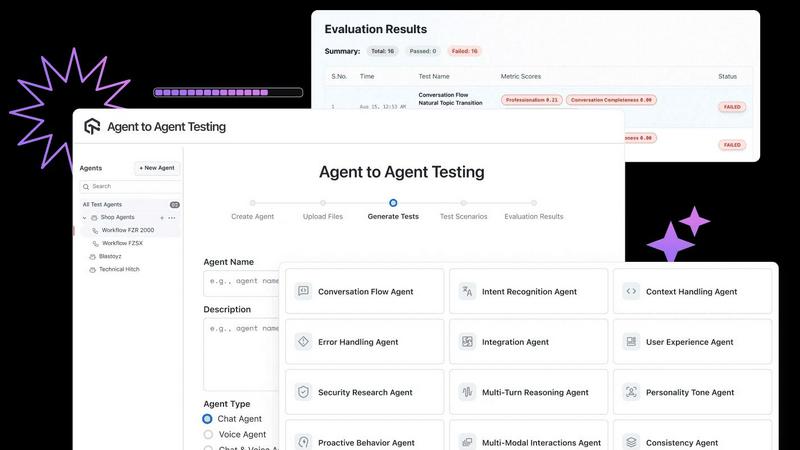
Agent to Agent Testing Platform
ninthsystemsagents
Feature Comparison
Agent to Agent Testing Platform
Autonomous Multi-Agent Test Generation
The platform employs a team of over 17 specialized AI agents to autonomously create diverse and complex test scenarios. These agents act as synthetic users, generating a vast array of conversational paths, edge cases, and long-tail interaction patterns that would be impractical to script manually. This ensures comprehensive coverage and uncovers failures that human testers are likely to miss.
True Multi-Modal Understanding and Testing
Go beyond text-based validation. The platform allows you to define requirements or upload PRDs (Product Requirement Documents) that include diverse inputs like images, audio, and video. It tests the AI agent's ability to understand and respond appropriately to these multi-modal inputs, accurately mirroring complex real-world user scenarios and interactions.
Diverse Persona-Based Testing
Simulate a wide spectrum of real human users by leveraging a library of diverse personas, such as an International Caller or a Digital Novice. This feature ensures your AI agent is tested against different user behaviors, accents, technical proficiencies, and needs, guaranteeing it performs effectively and empathetically for your entire user base, not just a homogeneous group.
Regression Testing with Intelligent Risk Scoring
Perform end-to-end regression testing for your AI agent with clear, prioritized insights. The platform provides a risk score that highlights potential areas of concern based on test results. This allows development and QA teams to quickly identify and prioritize critical issues, optimizing testing efforts and ensuring stability through continuous updates and deployments.
ninthsystemsagents
Enterprise Governance & Human-in-the-Loop Approvals
Our AI agents are engineered for secure enterprise deployment. Critical actions within any workflow can be configured to require explicit human approval before execution. This built-in safety mechanism ensures that agents operate within strict policy gates, providing oversight and control while automating complex processes. It combines the speed of AI with human judgment where it matters most.
Audit-Ready Execution Logs for Every Workflow
Every decision and action taken by an AI agent is meticulously logged in a detailed, immutable audit trail. This provides complete visibility into the agent's reasoning process, the data it accessed, and the operations it performed. These compliance-ready logs are essential for governance, troubleshooting, and demonstrating adherence to internal policies and external regulatory standards.
Custom Agent Development for Business Operations
We do not offer one-size-fits-all bots. Our service focuses on custom development, where we analyze your unique business tasks, knowledge bases, and system landscapes to design and deploy tailored AI agents. These agents integrate retrieval (RAG), structured decision logic, and automated tool-calling to execute specific operational workflows with precision.
Secure Integration with Core Business Systems
Ninth Systems Agents seamlessly connect to and operate within your existing technology stack. Agents are built to perform authenticated actions across a wide range of platforms, including Customer Relationship Management (CRM) software, analytics tools, customer support systems, and internal APIs. This allows for end-to-end workflow automation without disrupting your current operations.
Use Cases
Agent to Agent Testing Platform
Pre-Production Validation of Customer Service Bots
Before launching a new customer support chatbot or voice assistant, enterprises can use the platform to simulate thousands of customer interactions. This validates intent recognition, escalation logic, policy adherence (e.g., data privacy), and the overall conversational flow, ensuring the agent is ready for live deployment and reduces the risk of brand-damaging failures.
Ensuring Compliance and Reducing Toxicity/Bias
Organizations can proactively test AI agents for unintended bias, toxic responses, or compliance violations. By generating tests from diverse personas and checking for policy breaches, the platform helps mitigate legal, ethical, and reputational risks, ensuring AI interactions are safe, fair, and aligned with corporate and regulatory standards.
Continuous Testing for Agentic AI Pipelines
Integrate the platform into CI/CD pipelines for continuous validation of AI agents. Every time an agent's model, prompts, or knowledge base is updated, autonomous regression tests can run at scale to immediately detect regressions in performance, accuracy, or reasoning, maintaining high quality through rapid development cycles.
Performance Benchmarking Across Modalities
Compare and benchmark the performance of different AI agent models or configurations across chat, voice, and phone modalities. The platform provides detailed, consistent metrics on effectiveness, accuracy, empathy, and professionalism, enabling data-driven decisions to select and optimize the best agent for specific use cases.
ninthsystemsagents
Operations Workflow Standardization
Operations leaders can automate complex, manual runbooks to reduce bottlenecks and ensure consistent execution. AI agents can handle multi-step processes like procurement approvals, employee onboarding, or incident response, following predefined logic while providing real-time visibility and audit logs to management.
Customer Support Triage & Escalation
Customer support teams can deploy agents to automate initial ticket triage, information gathering, and escalation routing. The agent can retrieve customer history, apply decision logic to categorize issues, and execute actions like creating high-priority tickets or scheduling follow-ups, all while maintaining quality gates and reducing agent burnout.
Revenue Operations (RevOps) & CRM Hygiene
RevOps and data teams can use AI agents to maintain clean and actionable data in CRM and analytics systems. Agents can autonomously perform ongoing tasks like deduplicating records, updating stale lead information, enforcing data entry standards, and triggering pipeline maintenance workflows, leading to more reliable reporting.
Analytics & Reporting Automation
Business intelligence and operations teams can automate the generation and distribution of key reports. An AI agent can be tasked with querying data sources, applying business logic to analyze results, formatting findings, and executing actions to share reports via email or internal communication platforms on a scheduled basis.
Overview
About Agent to Agent Testing Platform
Agent to Agent Testing Platform is the first AI-native quality assurance framework specifically engineered for the unique challenges of agentic AI systems. As AI agents—such as chatbots, voice assistants, and phone caller agents—become more autonomous and complex, traditional software testing methods are rendered obsolete. This platform provides a dedicated assurance layer that validates AI behavior in real-world, dynamic environments. It moves beyond simple prompt checks to evaluate full, multi-turn conversations across chat, voice, phone, and multimodal experiences. Designed for enterprises deploying AI at scale, its core value proposition is de-risking production rollouts by proactively uncovering long-tail failures, edge cases, and problematic interaction patterns that manual testing cannot reliably find. By leveraging a team of specialized AI agents to autonomously generate and execute thousands of synthetic user tests, it delivers actionable insights on critical metrics like bias, toxicity, hallucination, and policy compliance, ensuring AI agents perform accurately, reliably, and safely for all end-users.
About ninthsystemsagents
Ninth Systems Agents is an enterprise AI agent development company that moves beyond conversational chatbots to deliver custom, production-ready AI agents for real business execution. We specialize in designing, building, and operating autonomous agents that execute multi-step workflows across your critical systems like CRM, analytics platforms, support desks, and internal APIs. Our core mission is to empower businesses to scale operations efficiently and reduce reliance on manual processes by turning static runbooks into dynamic, governed workflows.
Built for operations leaders, customer support teams, and RevOps professionals, our solution is for teams that require consistent execution, stringent governance, and measurable outcomes from automation. The main value proposition lies in a unique blend of advanced AI capabilities with enterprise-ready safety controls. Every agent we deploy operates within established guardrails, featuring built-in human approval gates, comprehensive audit log visibility, and role-based access controls. This ensures that AI-driven actions are not only intelligent and effective but also secure, compliant, and fully transparent, making them suitable for SOC 2-ready environments.
Frequently Asked Questions
Agent to Agent Testing Platform FAQ
What makes Agent to Agent Testing different from traditional QA?
Traditional QA is built for deterministic, static software with predictable outputs. AI agents are probabilistic, dynamic, and their behavior evolves through conversation. This platform is AI-native, using other AI agents to test these non-linear, multi-turn interactions for nuances like reasoning, tone, and context-handling that scripted tests cannot evaluate.
What types of AI agents can be tested with this platform?
The platform is designed to test a wide range of AI-powered conversational agents. This includes text-based chatbots, voice assistants (like IVR systems), phone caller agents, and hybrid agents that operate across multiple modalities (text, voice, image). It validates the full agentic system, not just the underlying LLM.
How does the platform generate relevant test scenarios?
It uses a suite of specialized AI agents (e.g., a Personality Tone Agent, Data Privacy Agent) to autonomously create test scenarios. You can also access a pre-built library of hundreds of scenarios or create custom ones by defining requirements or uploading documents (PRDs), ensuring tests are tailored to your agent's specific functions and expected user interactions.
Can I integrate this testing into my existing development workflow?
Yes. The platform seamlessly integrates with TestMu AI's HyperExecute for large-scale cloud execution. This allows you to incorporate autonomous AI agent testing into your CI/CD pipelines, triggering test suites at scale with minimal setup and receiving actionable, detailed evaluation reports within minutes to inform development decisions.
ninthsystemsagents FAQ
How are Ninth Systems AI agents different from chatbots?
Chatbots are primarily designed for conversational question-and-answer interactions. In contrast, Ninth Systems AI agents are built for workflow execution. They can autonomously perform multi-step tasks, make decisions based on business logic, and take real actions—such as updating a CRM record, creating a support ticket, or generating a report—across your software systems with full governance.
What kind of governance and safety controls do you provide?
We prioritize enterprise-grade governance. Our platform includes mandatory human-in-the-loop approvals for critical steps, detailed audit logs for every action an agent takes, and role-based access controls to manage who can deploy or modify agents. This framework is designed to meet SOC 2 compliance standards, ensuring safe and accountable automation.
Which business systems can your AI agents integrate with?
Our custom AI agents are designed to integrate with a wide array of core business systems. This typically includes popular CRM platforms (like Salesforce), customer support software, analytics and business intelligence tools, internal databases, and custom APIs. We analyze your specific tech stack during development to ensure seamless connectivity.
What is the process for developing a custom AI agent?
The process begins with an analysis of your specific business tasks and workflows. We then identify the optimal AI model and tools required. Our team designs the agent's decision logic, integrates it with your knowledge sources and systems, and implements the necessary governance guardrails. Finally, we deploy and operate the agent, providing ongoing support and iteration based on performance KPIs.
Alternatives
Agent to Agent Testing Platform Alternatives
Agent to Agent Testing Platform is a specialized AI-native quality assurance framework for validating autonomous AI agents. It belongs to the AI Assistants and agent testing category, providing a dedicated layer to evaluate multi-turn conversations across chat, voice, phone, and multimodal systems before production. Users may explore alternatives for various reasons, such as budget constraints, specific feature requirements not covered, or a need for a platform that integrates differently with their existing tech stack. The search often stems from a need to find the right balance of depth, scalability, and cost for their unique agentic AI validation challenges. When evaluating alternatives, prioritize solutions that offer comprehensive, multi-turn conversation testing beyond simple prompt checks. Look for capabilities in autonomous test generation, validation of security and compliance policies, and the ability to simulate realistic user interactions at scale to uncover edge cases and long-tail failures effectively.
ninthsystemsagents Alternatives
Ninth Systems Agents is a provider of custom, autonomous AI agents designed to execute complex, multi-step business workflows. It falls within the category of advanced AI assistants that move beyond simple chatbots to perform intelligent actions across platforms like CRMs and internal systems. Businesses often explore alternatives for several reasons. These can include budget constraints, a need for different feature sets like pre-built templates, a preference for self-service platforms over custom development, or specific integration requirements that a solution must meet. When evaluating alternatives, key considerations should include the depth of workflow automation, the quality of system integrations, the clarity of performance metrics, and the level of ongoing support. The ideal solution should align with your operational complexity and provide a clear path to measurable efficiency gains.